Rush hour on the Paris Metro at 8:30 a.m. packs bodies so tight that a bulky bag becomes everyone else’s problem. The bag strapped to your back or slung over your shoulder changes how those 40 minutes feel.
Most tote-versus-backpack comparisons treat this like a fashion question. The deciding factor has nothing to do with aesthetics. It comes down to how many transfers your commute has and what the weather does when you’re between them.
This one is for the daily transit rider, the person who spends 45 minutes or more on trains, buses, or bikes five days a week. If that sounds like your morning, the usual “just pick what looks good” advice falls apart fast.
Your Commute Type Decides the Bag, Not Your Outfit
The tote-versus-backpack debate gets framed around personal style so often that the real question gets buried.
A bag is a transit tool first. How it performs in a moving crowd, on a wet platform, or crammed between seats matters more than what it says about your wardrobe.
Short Hops on a Single Line
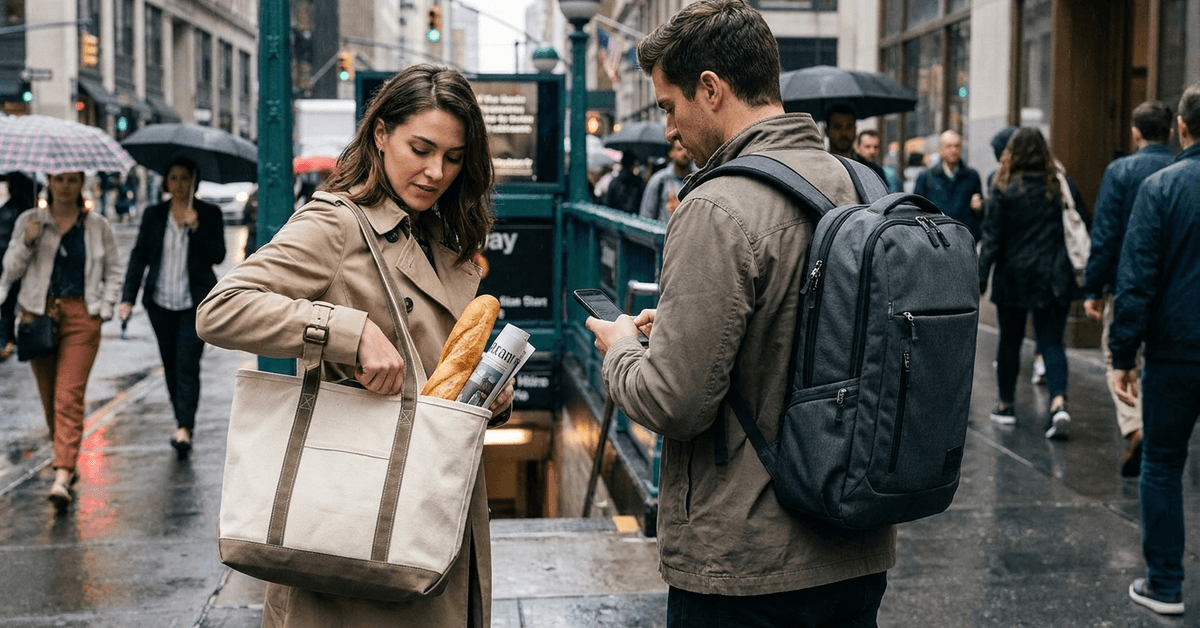
If your commute is one train and a five-minute walk, a tote bag works. Grabbing a transit card, phone, or water bottle takes one motion with an open-top tote. There’s zero fumbling with zippers.
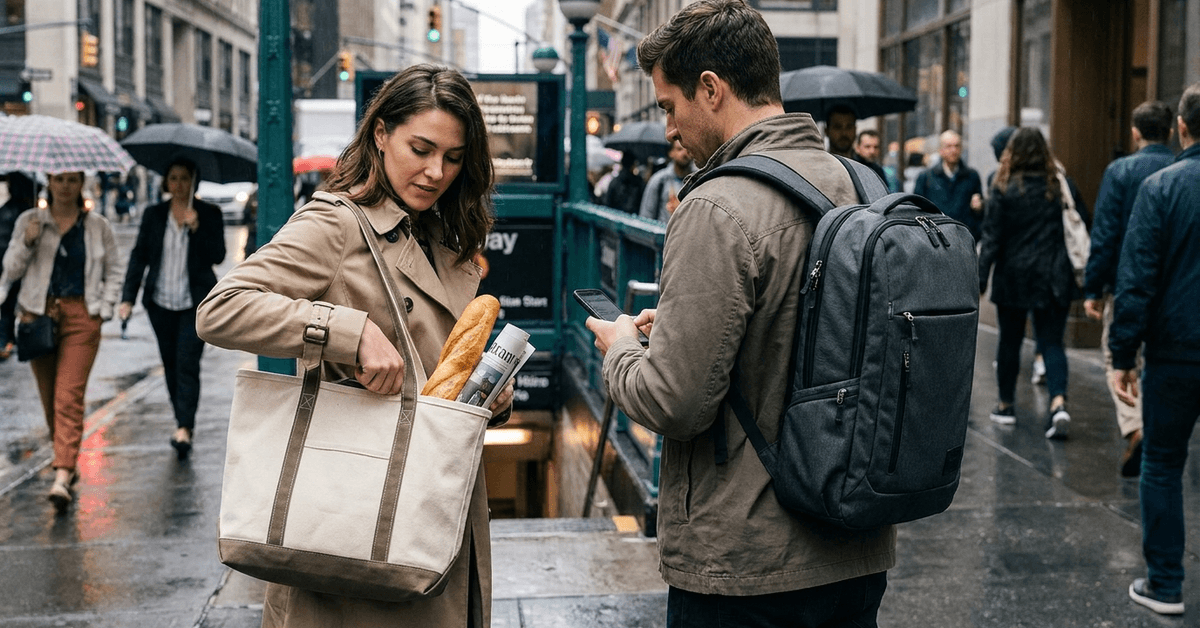
Milan cyclists doing short rides to work carry totes for this exact reason: the commute is brief enough that shoulder fatigue and weather risk stay low.
A 15-minute ride on the Central line in London? The tote handles it fine. But stretch that commute to 40 minutes across two transfers, and the single strap starts digging.
Multi-Transfer Commutes and Long Rides
A backpack distributes weight across both shoulders, and that difference compounds over time.
Carrying a laptop, charger, lunch, and a water bottle in a tote for an hour-long commute creates real discomfort by day three. The body notices uneven loading faster than most people expect.
Tokyo commuters almost universally carry sleek black backpacks on their long train rides.
Toronto riders doing a mix of transit and walking lean toward streamlined packs with dedicated laptop sleeves. These aren’t style choices. They’re responses to commute length.
Pickpocket Risk on Public Transit: Totes vs Backpacks
Security on public transit is a physical problem, not an abstract one. Cities like Barcelona, Rome, and the New York subway system have well-documented pickpocketing patterns, and the type of bag you carry changes your exposure.
The Open-Top Problem
Tote bags have no closure. An open top on a crowded platform or a packed festival lets someone reach in without much difficulty.
Keeping a tote pulled to the front of the body in dense crowds helps, and a small zippered pouch inside for a wallet and phone adds a layer of separation. But the structural vulnerability stays.
I’d argue that the standard advice to “just keep your tote in front” underestimates the problem. My take: if your daily commute runs through a station like Termini in Rome or Châtelet in Paris, a tote is a liability no matter how you hold it.
A zipped backpack worn on the chest through those specific stations is a measurably safer option.
Backpack Security Has Its Own Gaps
A backpack worn on the back in a crowded metro car isn’t safe either. The wearer can’t see what’s happening behind them.
Larger zipper pulls make a tempting target. Pacsafe makes anti-theft backpacks with lockable zippers and cut-resistant straps, and the brand is popular among riders on the Paris Metro and Prague trams.
The security answer depends on the station, not the bag. High-traffic transfer hubs demand a bag that closes and sits where you can see it.
Rain, Fabric and the Durability Gap
Weather splits the tote-versus-backpack comparison faster than any other factor. And most comparisons treat this as a footnote when it should be the first filter for half the cities on the planet.
Cotton Totes and Rain Don’t Mix
A standard cotton tote soaks through in minutes during an unexpected shower. Everything inside gets wet: the laptop, the notebook, the phone. Leather or faux-leather totes resist water better but add weight and take hours to dry once saturated.
Los Angeles commuters get away with canvas totes because rain is rare. That same bag in Amsterdam or Copenhagen becomes a problem by October.
Nylon Backpacks Dry Fast and Protect Tech
Most urban backpacks use nylon or polyester, which dries quickly and sheds light rain. Padded laptop compartments add shock and moisture protection. Copenhagen cycling commuters choose waterproof backpacks almost year-round.
A brand like Fjällräven has built a following across northern Europe partly because their packs survive five or more years of daily use in those conditions.
The durability gap here is real. A $15 cotton tote lasts a few months of heavy commuting. A $120 nylon backpack lasts years. The per-use cost flips the sticker price comparison.
Tote Bag vs Backpack: Side-by-Side for Commuters
The differences sharpen when compared across the same criteria. This table strips out the style conversation and focuses on the things that change your daily commute.
| Feature | Tote Bag | Backpack |
|---|---|---|
| Weight distribution | Single shoulder, uneven | Two straps, even load |
| Access speed | Instant, open top | Slower, zipped compartments |
| Rain protection | Poor (cotton), moderate (leather) | Good (nylon/polyester standard) |
| Pickpocket resistance | Low, open design | Moderate to high, zipped |
| Organization | One main compartment | Multiple sections, side pockets |
| Bulk on transit | Slim profile, fits tight spaces | Bulkier, bumps into passengers |
| Laptop safety | Minimal padding | Dedicated padded sleeve |
| Cost per year of use | Higher (shorter lifespan) | Lower (longer lifespan) |
The takeaway: backpacks win on function for commutes over 30 minutes. Totes win on access speed and slim fit for short, dry trips.
Organization Tricks That Change the Experience
Both bag types can be organized better than most people bother to do. The difference between a chaotic morning dig and a smooth grab comes down to internal structure.
A tote’s single-compartment design turns into a junk drawer without help. Removable organizer inserts (Purseket makes a popular one) divide that open space into sections for a wallet, keys, charger, and lip balm.
The insert lifts out when switching between bags, which is a nice trick for people who alternate between a tote and a backpack depending on the day.
Backpacks already have built-in separation. Side pouches hold water bottles or umbrellas. Internal zip pockets keep a charger cord from tangling with headphones. The organizational advantage grows with the number of items carried.
If your daily load includes a laptop, gym clothes, and lunch, a backpack’s structure prevents the pile-up that makes a tote feel heavier than it is.
Posture and Comfort Over a Full Work Week
One day with a loaded tote feels fine. Five days in a row tells a different story. Carrying 4 to 6 kilos on one shoulder creates an uneven pull that the body compensates for by shifting posture.
Over weeks and months, that compensation can lead to neck stiffness and shoulder tension.
Backpacks spread the same load across both shoulders and the upper back. The effect on comfort is noticeable even within a single commute.
Orthopedic specialists in transit-heavy cities tend to recommend backpacks for anyone walking more than 20 minutes as part of their daily route.
I think the popular advice that “a tote is fine if you pack light” misses the mark, because even a load under 3 kilos creates uneven strain when carried on one shoulder for 45 minutes on a packed Tube ride five days a week.
The threshold for “light enough” is lower than most people assume.
Matching the Bag to the Day, Not Just the Commute
A rigid one-bag-only rule ignores how city days shift. The smarter move for daily transit riders is to pick a primary bag based on the commute, then use the other for specific situations.
The primary bag should match the majority of the commute:
- Commutes over 30 minutes or involving rain-prone cities: backpack as the default
- Commutes under 20 minutes on a single dry route: tote works as the daily option
- Days involving a client meeting or gallery opening: a tote may fit the dress code better than a sporty pack
- Days with gym gear, multiple stops, or changing weather: backpack handles the load and keeps things organized
The Citymapper app handles real-time route planning across London, New York, and Berlin, and it can help determine whether a particular day’s transit plan is a short tote day or a long backpack day.
Tile and AirTag trackers work inside either bag type for anyone prone to leaving things behind. Tuck one inside the laptop sleeve or the organizer insert, and the bag becomes findable.
Questions People Ask About Tote Bags vs Backpacks for Commuting
These come up constantly in transit and urban planning forums, so let me cover the ones that rarely get a straight answer.
- Q: Can a tote bag work for a daily commute with a laptop? It can, but only if the commute is short and dry. A laptop bouncing around in an unpadded cotton tote on a 40-minute bus ride risks both the device and your shoulder. Padded laptop totes exist, but they start approaching backpack weight and price.
- Q: Are anti-theft backpacks worth the higher price? For commuters riding through high-traffic stations daily, yes. Pacsafe’s lockable zippers and slash-resistant panels add $40 to $80 over a standard pack, and that gap pays for itself the first time it prevents a loss. For low-traffic suburban routes, a regular zipped backpack does the job.
- Q: Do backpacks damage dress clothes on a formal commute? They can. Textured straps rub against suit jackets and blouses over repeated use. A smooth-strap design or placing a thin cloth between the strap and the fabric reduces this. Some professionals carry a garment bag separately and use the backpack for everything else.
- Q: How often should a daily commuter replace their bag? Cotton totes used daily show wear within three to six months. Nylon backpacks from mid-range brands hold up for two to four years. Fjällräven and similar outdoor-grade packs stretch to five years or longer, even in wet climates.
- Q: Is a convertible tote-backpack a good compromise? The hybrid designs sound appealing but usually sacrifice quality in both modes. Straps that convert from single to double tend to wear out faster, and the bag sits awkwardly in one of the two configurations. Owning a dedicated tote and a dedicated backpack gives better performance for roughly the same total cost.
Conclusion
Picking between a tote and a backpack depends on commute length, weather, and how many items travel daily. The bag that matches your specific transit pattern will outperform the one that matches your outfit.
Commuters covering long routes in rain-heavy cities get more from a structured, water-resistant backpack. Short dry hops in cities with minimal transfers leave plenty of room for the speed and slim profile of a tote.