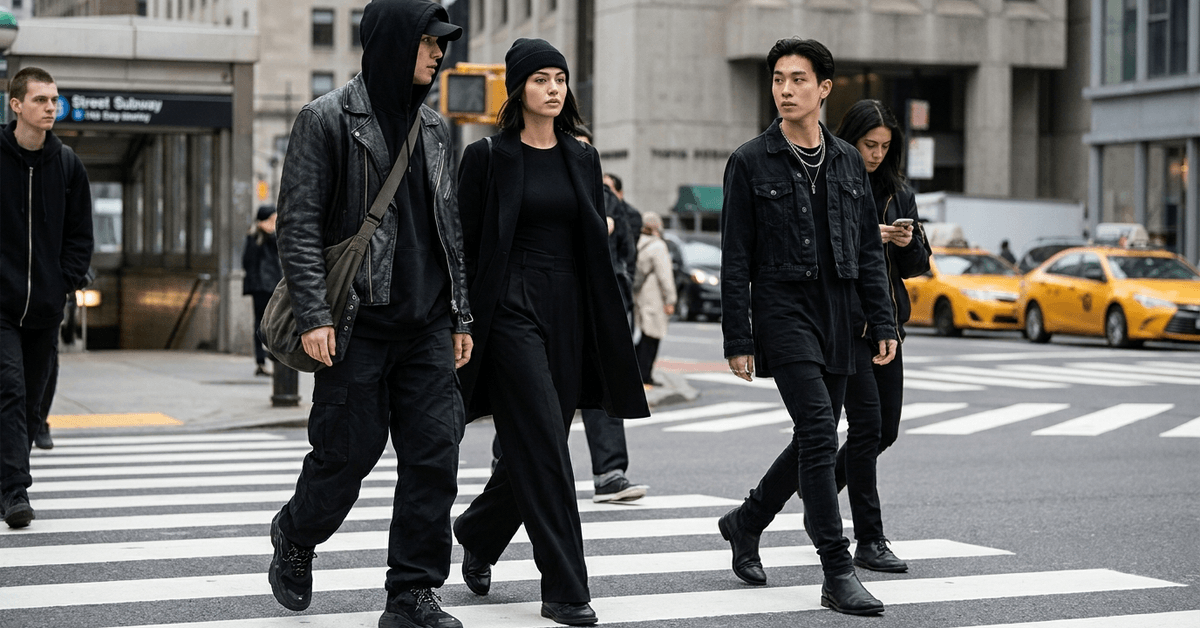
An all-black outfit should be the easiest thing to pull off. Grab dark jeans, a black tee, black sneakers, done. So why do most people who dress head-to-toe black still look like they grabbed whatever was closest to the bed?
The usual advice points to texture. “Mix leather and cotton.” “Add a nylon layer.” That answer sounds right, but it skips the thing that makes or breaks an all-black look before fabric even enters the picture: proportion.
This one is for the city commuter who already owns fifteen black garments and still can’t figure out why the outfit reads “laundry day” instead of “intentional.” The fix is simpler and more specific than most style guides make it.
Proportion Does More Work Than Texture Ever Will
Every all-black streetwear guide opens on fabric mixing. Leather jacket over cotton hoodie, nylon shell over denim.
I would argue that proportion and silhouette control about 80% of the visual weight in a monochrome outfit, based on how drastically a tucked-in tee changes the same pair of wide-leg trousers.
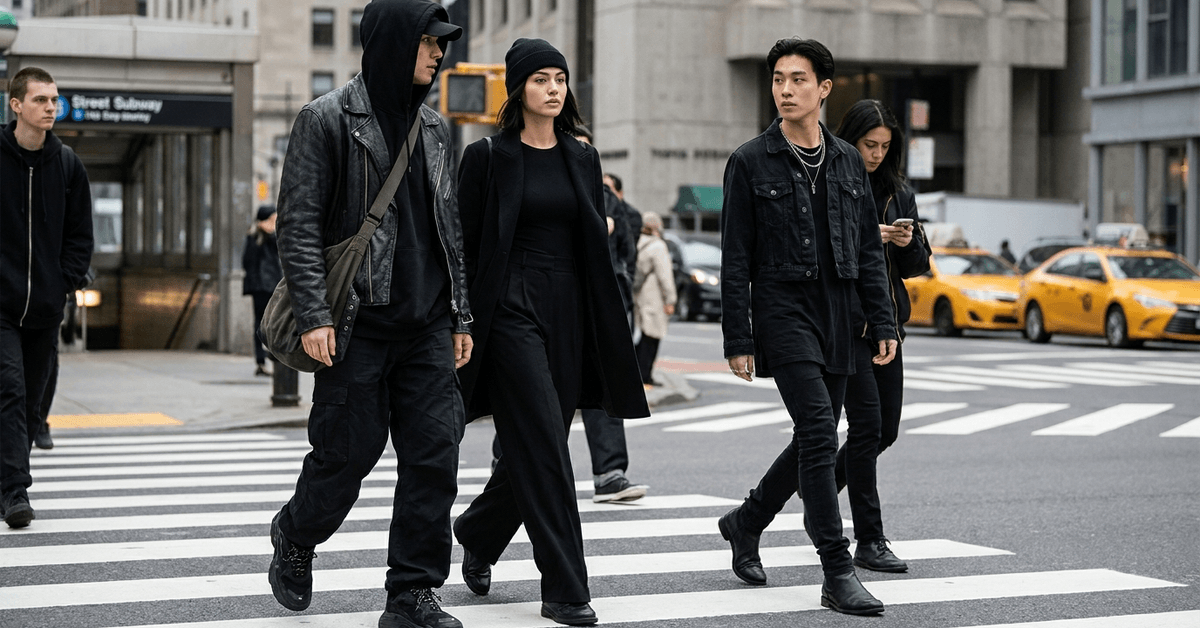
Think about it. Two people wearing identical all-black outfits: same fabrics, same brands, same price point. One pairs slim black trousers with a boxy cropped jacket.
The other wears skinny jeans under an oversized hoodie that hits mid-thigh. Same color palette. Completely different energy.
Color contrast does half the styling work for people who wear multiple shades. Remove that tool, and the only variables left are shape and volume. That’s why proportion runs the show in monochrome.
Loose-on-Tight vs Tight-on-Loose
The two proportion formulas that consistently work in all-black are simple. Pair a fitted top half with a relaxed bottom, or flip it: oversized top with tapered legs.
A slim black tee tucked into wide-leg cargo pants reads relaxed and deliberate. A cropped black jacket over slim trousers reads sharp without trying too hard. Both work across genders and seasons.
The combination that almost always falls flat? Loose on loose. An oversized hoodie with baggy joggers in the same shade just reads shapeless. There’s no tension, no visual anchor for the eye. Fit contrast is the replacement for color contrast.
Texture Mixing That Earns Its Place
Texture does matter. But it works as a supporting player, not the lead. Swapping cotton for leather means nothing if the silhouette is already dead.
Once proportions are set, fabric differences add dimension within a shape that already reads well. The distinction matters: texture amplifies a good fit. It does not rescue a bad one.
Fabrics That Create Real Contrast in Black
Some fabric pairings create more visual separation than others when everything is the same shade. The ones worth reaching for:
- Matte leather against ribbed cotton: a leather bomber over a ribbed tank top produces two distinct sheens that catch light differently
- Heavyweight denim over smooth jersey: a black denim overshirt layered on a jersey tee creates a stiff-versus-soft dynamic
- Technical nylon against brushed fleece: common in cities like London and Berlin where rain and cold hit in the same afternoon
Shiny-on-matte creates the strongest visual separation. Two matte fabrics next to each other barely register as different in street-level lighting.
Layering for Cities That Change Weather by the Hour
Layering is where all-black streetwear picks up depth for free. Each layer adds a new line, a new edge where the eye can catch a transition.
The approach that works best in cities like London, Tokyo, or Amsterdam follows a simple three-piece logic: a fitted base layer, a mid-weight piece that carries the silhouette, and an outer shell that handles weather.
Base, Mid, Shell: The Three-Piece Framework
A slim black Airism tee from Uniqlo’s Airism line sits flat against the skin and wicks moisture in humid climates like Singapore or New York summers. That’s the base.
Over it, a black denim overshirt or a lightweight black gilet adds the shape. This mid-layer is the piece people see. Choose it for structure.
The outer shell is practical: a technical nylon jacket that packs down when the sun comes out. Don’t over-style this piece. It should disappear when you take it off and leave a complete outfit behind.
Switching a Look Between Day and Night Without Changing Clothes
Most style guides suggest swapping sneakers for boots or adding a blazer after dark. My take on the day-to-night shift is that the swap approach fails most commuters, because nobody carries spare boots through a twelve-hour day in Seoul or Paris.
A simpler method: adjust how existing pieces sit. Roll jacket sleeves to expose a watch or bracelet. Untuck a shirt that was tucked all day. Swap a backpack to a crossbody sling. These micro-adjustments change the visual profile without requiring a second wardrobe in a tote bag.
Even switching which layer sits on top changes an outfit. A hoodie under an open overshirt reads different from the same hoodie worn over a zipped jacket. Same two pieces, reversed order, new look.
Accessories That Break Monotone Without Breaking the Palette
All-black accessories risk blending into the outfit and adding zero visual interest. The trick is hardware: silver zippers, metal buckles, chrome watch faces, and chain-link jewelry break up the monotone through reflection, not color.
A chunky silver chain over a plain black tee does more work than a $200 textured knit. Metallics catch city light: streetlamps, neon signs, subway fluorescents. That reflected light becomes the accent color.
Hardware, Metallics, and What City Light Does for Free
Accessories worth considering for an urban all-black rotation:
- Chunky silver or gunmetal rings that catch light during hand gestures
- A matte black crossbody sling bag with exposed metal hardware
- High-top boots with visible eyelets or buckles, especially useful on city sidewalks where footwear takes the most abuse
- A minimal black-dial watch with a steel bracelet: one of the few accessories that transitions from subway to rooftop bar without looking out of place
The urban crowd in cities like Seoul and Tokyo tends to treat accessories as the individuality layer. Two people can wear the same Uniqlo base outfit and look nothing alike based on bag choice and jewelry alone.
Brands like Grailed list vintage and limited-edition accessories that add personality without the full retail hit. Older Comme des Garçons pieces or discontinued Patta collaborations often carry subtle tonal logos that only register up close.
Keeping Black Clothes Black: The Fading Problem Nobody Styles Around
This is the part that quietly ruins all-black outfits faster than bad proportions or wrong fabrics. Black garments fade at different rates.
A cotton tee washed weekly fades faster than a denim jacket worn monthly. After two months, an “all-black” outfit becomes three slightly different shades of charcoal, grey-black, and true black.
That shade mismatch reads as accidental. And accidental is the one thing a monochrome outfit cannot afford to look.
Managing Fade So Pieces Still Match
A few habits keep the color consistent across a wardrobe:
- Wash black clothes inside-out on cold settings with a color-safe detergent: hot water accelerates dye loss
- Air-dry instead of machine-drying whenever possible: dryer heat breaks down black dye faster than washing does
- Rotate pieces evenly so no single garment fades ahead of the rest
- Fabric-safe black dye is available at most hardware stores for a quick color refresh on faded favorites
| Care Factor | Do This | Avoid This |
|---|---|---|
| Washing | Cold water, inside-out, gentle cycle | Hot water, heavy spin |
| Drying | Air-dry flat or on a hanger | High-heat tumble dryer |
| Storage | Fold dark pieces away from direct sunlight | Leaving on a sunny windowsill rack |
| Refresh | Black fabric dye every 3-4 months for heavy-rotation items | Ignoring gradual fading until pieces look grey |
The quickest tell of a careless all-black wardrobe is two pieces next to each other in noticeably different shades of “black.”
And a lint roller belongs in every commuter bag. Black fabric picks up dust, pet hair, and subway lint within an hour of leaving the house. A quick pass before walking into a meeting or a dinner keeps the look sharp.
Questions People Ask About All-Black Streetwear Outfits
These come up constantly when people try to build a monochrome city wardrobe.
- Q: How do I make an all-black outfit look expensive on a budget?
Fit and proportion do most of the heavy lifting. A $15 black tee that fits well looks more put-together than a $90 oversized one that drowns the frame. Spend more on outerwear and shoes, since those two categories get judged hardest at a glance. - Q: Does all-black work in hot weather?
It can, as long as fabrics are lightweight and breathable. Airism-style moisture-wicking tees paired with linen-blend trousers keep the palette dark without turning a summer commute into a sauna. Stick to single layers when temperatures climb above 30°C. - Q: Are logos acceptable in an all-black streetwear outfit?
Tonal logos and subtle prints work better than high-contrast branding. A black-on-black logo near the hem or sleeve reads intentional without shouting. Brands like Comme des Garçons and Patta specialize in this kind of understated graphic placement. - Q: How many black pieces do I need for a solid rotation?
A working rotation needs around eight to ten pieces across tops, bottoms, and outerwear. That gives enough variety to avoid repeating the same combination within a week, and it spreads wash cycles so no single piece fades ahead of the others. - Q: Can all-black streetwear work in professional settings?
Absolutely, with one adjustment. Swap casual pieces for structured ones: a tailored black blazer over slim trousers reads office-appropriate while keeping the streetwear silhouette. The trick is clean lines and minimal branding during work hours.
Conclusion
All-black streetwear works best when proportion, not fabric variety, sets the foundation for the whole outfit. Fading control is the invisible maintenance step that separates a sharp monochrome wardrobe from a dull one.
Accessories built around metal hardware give city light something to catch without introducing a single new color. The commuter who nails these three details owns the look without thinking about it.