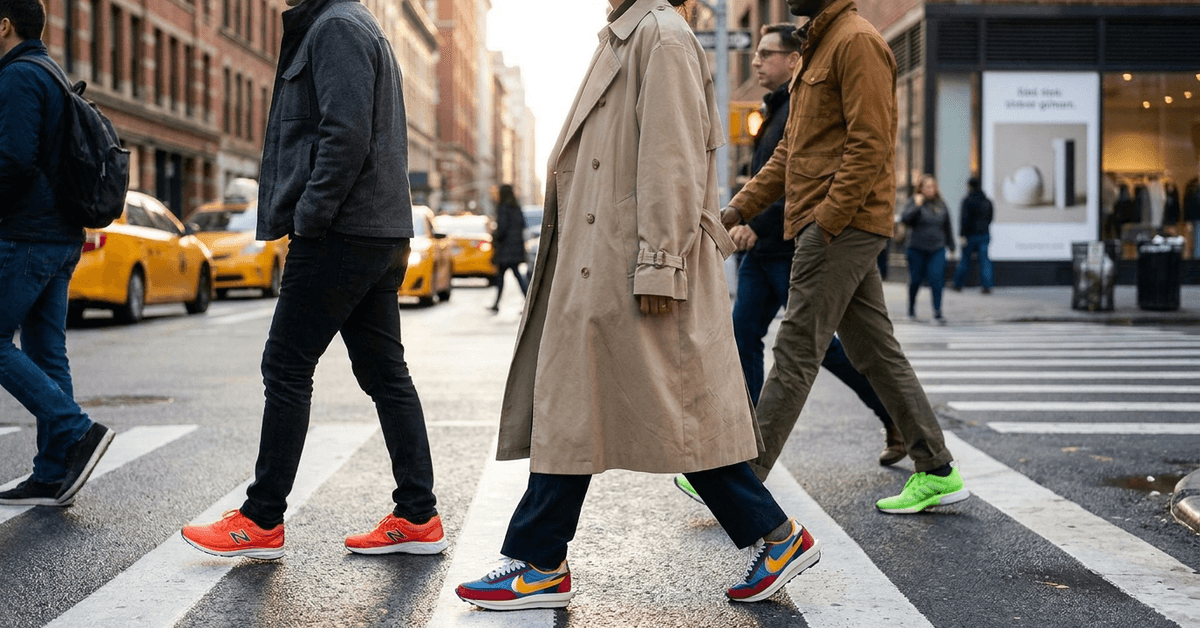
Most bright sneaker purchases go wrong before the box opens. The buyer picks a color they love, ignores the shoe’s shape, and ends up with a pair that fights every trouser hem in their closet.
The color gets all the attention in pairing guides. But the silhouette of a bright sneaker determines 80% of whether the outfit looks planned or panicked.
This guide is for the city commuter who already owns a closet full of black, gray, and beige, and wants one pair of loud sneakers that works across the whole rotation without thinking too hard every morning.
Why Silhouette Matters More Than Color When Picking Bright Sneakers
Every bright sneaker guide starts with color. Red goes with gray. Turquoise pops against cream. That advice is fine, but it skips the part where the outfit falls apart: the shape of the shoe meeting the shape of the pant leg.
A chunky neon sneaker under slim-cut trousers creates a visual weight mismatch that no amount of color coordination can fix. And a sleek low-top under wide-leg joggers makes the shoe disappear, which defeats the purpose of going bright in the first place.
Low-Tops vs Chunky Soles and the Wardrobe They Demand
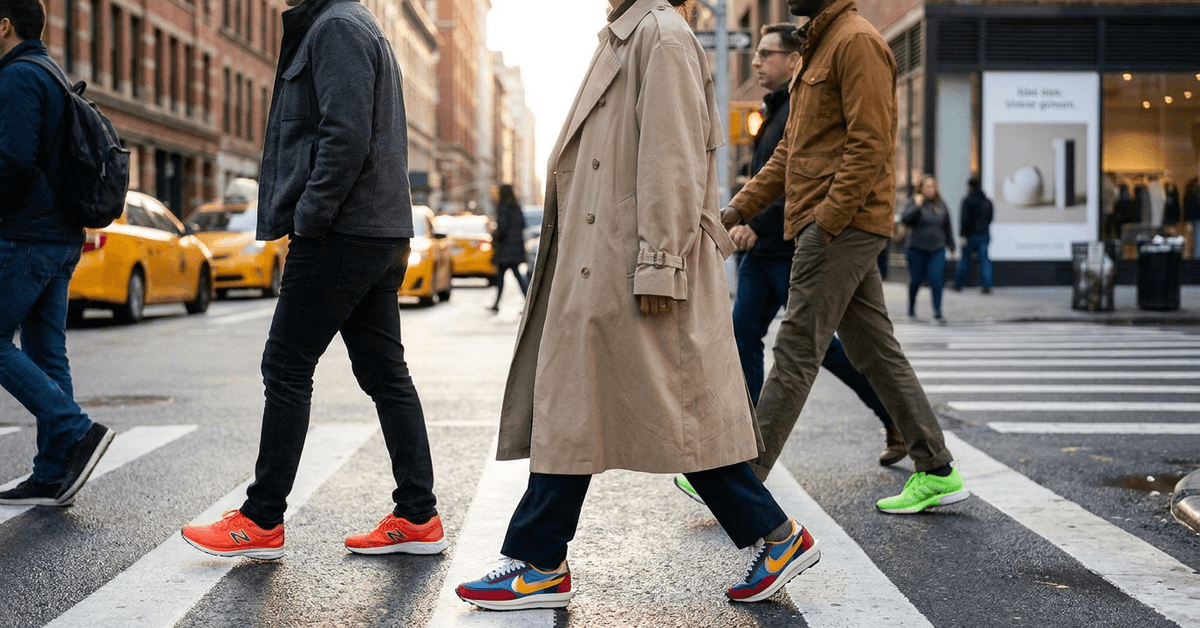
Low-top bright sneakers pair well with tapered chinos, slim jeans, and cropped trousers. The shoe sits close to the ankle, so the transition between pant and sneaker stays clean. Cities like Berlin and Amsterdam lean toward this sleeker profile, partly because cycling culture rewards shoes that don’t catch on pedals.
Chunky or platform bright sneakers need roomier pants to balance the proportions. Relaxed denim, straight-leg trousers, and joggers all give the shoe enough visual space. New York and London trend toward this bulkier silhouette, where the shoe is meant to be the loudest piece on the body.
How Your City Should Shape Your Sneaker Choice
I’d argue that geography should influence silhouette more than personal taste when picking bright sneakers for daily commuting. A chunky neon runner that looks sharp on a Brooklyn sidewalk can look out of place on a Copenhagen bike lane.
The raw trend data backs this up: Stockholm leans toward tonal neutrals with reflective sneaker details for after-dark cycling safety, while Tokyo pairs structured technical fabrics with clean lines and utility accessories.
The smarter move is to watch commuters in your own neighborhood for a week. Train platforms and bus stops are better style labs than Instagram hashtags. Pay attention to what shoe shapes show up most often with neutral outfits, and buy into that silhouette.
Color Pairing Bright Sneakers the Intentional Way
Once the silhouette matches the wardrobe, color becomes a much easier decision. The goal is to make the bright sneaker look chosen, not accidental.
All-Black Outfits Are the Laziest Base for Bright Sneakers
I think the all-black-plus-bright-sneakers formula that every style guide recommends is a crutch. My issue is specific: a solid black outfit creates so much contrast that the sneakers look like they belong to a different person.
The eye jumps straight to the feet and ignores every other styling decision.
Earth tones do a better job. Tans, stone, off-white, and khaki create a warmer gradient that lets a bright sneaker feel like part of the outfit instead of a neon sign strapped to the ankles.
Urban commuters in Copenhagen and Milan pair beige chinos with a khaki trench and orange or lime sneakers, and the result reads as intentional. If an all-black base feels necessary, layer different textures to break up the monochrome. Cotton over linen, a leather jacket over a knit.
Add a light gray scarf or hat to create a step between the black clothing and the bright shoe. That middle shade softens the contrast.
The White Canvas Approach
A full white outfit works as a blank canvas for neon green, hot pink, or patterned sneakers. City walkers in Barcelona use this approach frequently during spring markets and festivals.
The trick to keeping a white outfit from looking clinical: break it up with a textured belt or a crossbody bag in a muted tone. A smartphone case matching the sneaker color creates a small visual callback without being obvious about it.
Picking Colors That Match Your Existing Neutrals
Not every bright sneaker color works with every neutral base. The combinations that tend to work best break down like this:
| Neutral Base | Strong Sneaker Colors | Weaker Pairings |
|---|---|---|
| Gray and charcoal | Red, yellow, cobalt blue | Neon green (too jarring) |
| Beige and tan | Orange, lime, turquoise | Hot pink (clashes warm tones) |
| White and cream | Neon green, pink, patterned | Yellow (low contrast, washes out) |
Multi-color soles add flexibility here, since they pull from several palette families at once and match more outfits across a week of commuting.
Accessories That Stay Out of the Sneaker’s Way
The instinct when wearing bright sneakers is to match accessories aggressively. Bright watch, bright bag, bright hat. This usually backfires. Too many color accents scatter the eye and the sneakers lose their punch.
The One-Repeat Rule
A single, small accessory that echoes the sneaker color is enough. The rest of the accessories should stay neutral. Some pairings that work:
- A watch with a colored strap in the same family as the sneaker accent
- A thin cord bracelet in a muted version of the shoe’s color (popular in Paris as a subtle link between shoe and wrist)
- A phone grip or case matching the sneaker shade
Anything beyond that starts competing. Minimalist canvas totes and simple metal wristwear let the shoes stay in focus without making the rest of the outfit feel empty.
Bags and Layers That Complement, Not Compete
A crossbody bag in a complementary neutral shade ties the look together without adding another loud color.
An off-white backpack works well with earth-toned outfits and loud soles. The bag should serve a function (carrying a laptop, a water bottle, a book) and the color should feel like a background player.
For cold weather layering, windbreakers and oversized knits in muted colors keep the sneaker as the standout piece. Matching high socks to the neutral palette rather than the shoe color prevents the lower half of the outfit from becoming a color circus.
Keeping Bright Sneakers Clean in City Conditions
Bright colors show dirt faster than black or white shoes. Dust, rain splatter, and subway grime all become visible within a day or two of city wear. Cleaning and rotation are non-negotiable if the shoes are supposed to look sharp.
Daily and Weekly Sneaker Maintenance
A few habits make a real difference in how long bright sneakers hold their color:
- Mini cleaning wipes from brands like Crep Protect fit into a back pocket or small bag compartment and handle surface stains on the go
- Compact travel brushes take care of deeper scuffs during a lunch break or between meetings
- Shoe trees placed inside after each wear prevent creasing and keep the shape intact
- Avoiding direct sunlight during storage slows color fading on neon and pastel shades
Rotation Saves Money Long-Term
Owning two pairs of bright sneakers and alternating daily extends the life of both. The materials get a full day to breathe and dry between wears, which prevents the kind of sole breakdown that turns a six-month shoe into a three-month shoe.
Getting Style Ideas Without Falling Into Algorithm Traps
Most style apps push trending content that may not match the specific neutral-plus-bright formula. Searching strategically works better than scrolling passively.
On Pinterest, build a dedicated board for bright sneaker pairings and save only outfits that match the neutral base colors already in the closet.
Lookbook shows what locals wear in cities like Tokyo and Melbourne, which helps calibrate expectations for what a bright sneaker outfit looks like on a real commuter versus a professional model.
Streetwear hashtags on social platforms can spark ideas, but the better research method is paying attention to real commuters. A morning train in Toronto or a tram stop in Madrid will show dozens of neutral-plus-bright combinations that no algorithm curates.
Questions People Ask About Bright Sneakers and Neutral Outfits
A few of the most common questions about pulling off this look, answered quickly.
- Q: Can bright sneakers work in a business casual office?
Low-top sneakers in a single bold color (not neon) pair fine with chinos and a blazer in most business casual settings. The test is whether the shoe could pass for a fashion choice or reads as athletic wear. Chunky soles tend to push past that line. - Q: How many pairs of bright sneakers should I own?
Two is the practical sweet spot. One warm-toned pair (red, orange, yellow) and one cool-toned pair (blue, green, purple) cover most neutral wardrobes without creating closet clutter. Rotation also extends the life of each pair. - Q: Do bright sneakers work in winter?
Absolutely, though the approach shifts. Pair them with heavier textures like wool trousers and layered knits. Reflective details on sneakers (common in Scandinavian brands) add a safety element for short winter daylight. - Q: What is the easiest first bright sneaker color to buy?
Red is the safest entry point because it pairs equally well with gray, black, navy, and tan. A clean red low-top is about as versatile as a bright sneaker gets, and it works across seasons without looking seasonal. - Q: Are multi-color sneakers harder to pair than single-color ones?
They can be easier, surprisingly. Multi-color soles pull from several palette families, so they tend to match more outfits across a week than a single bold shade. The tradeoff is that they draw more attention, which means the rest of the outfit needs to stay quieter.
Conclusion
Bright sneakers paired with a neutral wardrobe create an easy daily formula that scales across seasons. The silhouette of the shoe matters more than the color for making the outfit look cohesive.
Earth tones and textured layers give the sneakers room to stand out without visual chaos. Start with one pair of red low-tops, and the rest of the wardrobe falls into place.