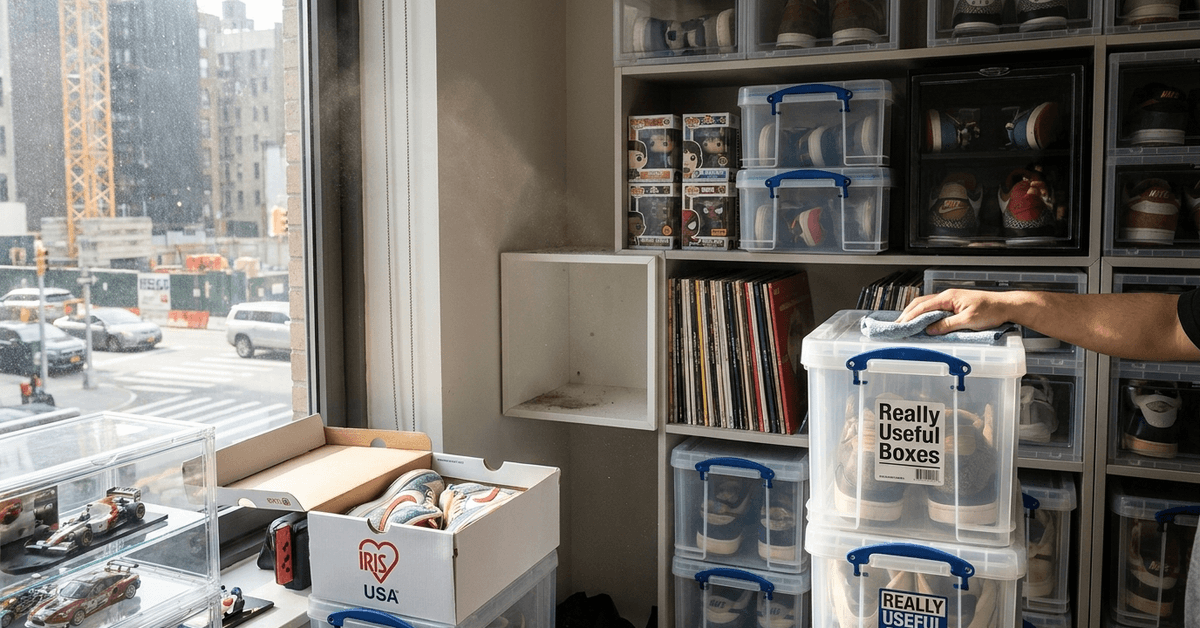
A gasket-sealed IRIS USA container costs around $15 to $25 per unit. Stack ten of those in a Tokyo studio or a Brooklyn one-bedroom, and the storage budget creeps past $200 before a single shelf is mounted.
Most collector guides push airtight everything. Seal it up, lock it down, forget about it. But airtight storage in a humid 400-square-foot apartment creates a different problem: trapped moisture that breeds mildew.
This article is for the urban collector living in a compact apartment, someone juggling limited-edition sneakers, resin figurines, or boxed vinyl across a few shelves and a closet. The kind of person who loses sleep over a thin film of city grime on a $300 pair of shoes.
The Seal Everyone Obsesses Over and the Problem It Hides
Seal quality dominates every storage box recommendation for collectors. And yeah, a tight seal blocks dust. Nobody disputes that. Snap-latch closures, rubberized gaskets, and solid molded lids all outperform a basic clip-on lid when it comes to keeping fine particles out.
But I would skip fully airtight containers for any collection stored in apartments without climate control, especially IRIS USA gasket models in humid cities like New York or London. The reason is simple: those rubberized seals trap ambient moisture inside the box.
Open the container in August humidity, close it, and the moisture stays locked in. Over months, that sealed environment can produce mildew spots on cardboard packaging, paper inserts, and fabric surfaces.
Gasket Seals vs. Snap-Latch Lids
Gasket-sealed containers like the IRIS USA Weathertight series use a rubberized edge that compresses against the lid. Dust protection is among the best you can buy at the consumer level. The tradeoff is zero airflow.
Snap-latch boxes, like those from Really Useful Box, click firmly but allow a microscopic amount of air exchange.
For collections that sit in non-climate-controlled closets, that tiny bit of breathing room can prevent condensation buildup between seasonal temperature shifts.
When Airtight Storage Makes Sense
Airtight containers work well in two specific situations: climate-controlled rooms where humidity stays below 50%, and long-term storage where the box stays closed for six months or longer.
If your apartment runs a dehumidifier or central air year-round, the IRIS USA gasket containers are a strong pick. Otherwise, the seal that blocks dust may quietly damage what it protects.
How Often Do You Open the Box? That Matters More Than the Lid
The biggest dust entry point for most urban collectors is not a bad seal. It is the moment the lid comes off.
Every time a box opens, city air rushes in. Apartments near busy roads, construction zones, or public transit lines carry higher concentrations of fine particulate matter.
A collector who opens a box weekly to swap display items introduces more dust than someone with a mediocre seal who rarely touches the container.
The Access Frequency Problem
Think about how your collection works in practice. A sneaker rotation means opening boxes several times a week. A vinyl record collection might see daily pulls. Compare that to a figurine collection that sits untouched for months.
The storage strategy should match the access pattern:
- High-access items (sneakers, vinyl, trading cards in active use): stackable drawer units beat lidded boxes because drawers open from the front without disturbing stacked containers above
- Medium-access items (seasonal display pieces, recent pickups waiting for shelf space): snap-latch boxes like Really Useful Box, stored at arm height for easy reach
- Low-access items (graded comics, sealed collectibles, long-term holds): airtight gasket containers pushed to high shelves or closet tops
This three-tier approach is something I rarely see in collector storage guides, and I think it matters more than any individual box recommendation from IRIS USA or Really Useful Box.
Stacking Storage in Apartments Under 600 Square Feet
Vertical space is the only real estate most city collectors have left. A floor-to-ceiling shelving unit with uniform box sizes can hold twice the collection of scattered containers across different rooms.
Uniform Box Sizes Save More Space Than Mixed Sets
Collectors in Berlin and Hong Kong figured this out early. Buying the same model and size of storage box across your entire collection means every unit stacks flush. Mixed sizes create gaps. Gaps waste vertical inches. And in a studio apartment, those inches add up fast.
Really Useful Box sells in standardized dimensions that nest and stack cleanly. Muji’s clear polypropylene boxes follow the same logic, with a minimalist look that blends into tight living spaces.
Keep Boxes Off Window Ledges and Heating Vents
Two spots attract the most dust in a city apartment: near windows and above heating vents. Thermal currents carry particles upward and deposit them on surfaces near heat sources. Boxes stored on high shelves above radiators accumulate dust faster than identical boxes at waist height in a hallway closet.
| Brand | Seal Type | Best Use Case | Typical Price Range |
|---|---|---|---|
| IRIS USA Weathertight | Rubberized gasket | Long-term storage in climate-controlled spaces | $15–$25 per unit |
| Really Useful Box | Snap-latch | Frequent-access collections, stackable setups | $8–$18 per unit |
| Muji Clear PP | Press-fit lid | Display-adjacent storage, minimalist apartments | $10–$20 per unit |
| IKEA Samla | Clip-on lid (optional gasket) | Budget bulk storage, modular shelving | $5–$12 per unit |
IKEA Samla is the cheapest per unit but offers the weakest dust protection of the four. For budget-conscious collectors, pairing Samla boxes with aftermarket silicone weatherstrip tape along the lid edge can close the gap for a couple of dollars extra.
Protecting Different Types of Collectibles
Not every collection needs the same box. The material, shape, and fragility of what you collect should drive the choice.
Sneakers and Shoes
Drop-front shoe boxes made from clear acrylic or thick polystyrene are popular for sneaker collectors. These open from the front panel, so stacked units stay undisturbed during access. Dust protection is moderate: the front panel rarely seals flush. Adding a thin strip of adhesive foam weatherstrip along the front edge improves the seal noticeably.
Vinyl Records and Comic Books
Vinyl records need upright storage to prevent warping. A latching box wide enough to hold records vertically, like the Really Useful Box 9L, fits roughly 40 to 50 records standing up. Acid-free dividers inside the box keep sleeves from sticking together.
Comic collectors dealing with bagged-and-boarded issues can use standard short boxes, but those cardboard containers are dust magnets. Placing the entire cardboard short box inside a larger snap-latch plastic container adds a second layer of protection without re-bagging everything.
Resin Figurines and Statues
Glass-front display cases offer the best balance between visibility and protection. They are not fully sealed, but the enclosed cabinet reduces dust exposure by roughly 80% compared to open shelving. IKEA’s Detolf is the go-to budget option for figurine collectors worldwide. Custom-built cases from local shops can match exact shelf heights for odd-sized statues.
Maintenance Habits That Save Collections
Buying the right box gets you halfway there. The other half is keeping up with a minimal cleaning routine.
A bi-weekly wipe of the outside of each container prevents dust from entering when the lid opens. Microfiber cloths work better than paper towels because they trap particles instead of pushing them around.
- Check gasket seals every six months. Rubber degrades, especially after apartment moves where boxes get jostled. A cracked gasket on an IRIS USA container can be replaced for a few dollars rather than buying a new box.
- Rotate display items quarterly. Pieces on open shelves collect the most dust. Swapping them into sealed storage every few months keeps everything cleaner and gives the collection a fresh look.
- Use shelf liners inside containers. Thin felt or foam pads catch particles that sneak in during opening. They also prevent scuffs on delicate surfaces when items shift during a move.
Inventory tracking helps too. Apps like Sortly let you photograph and tag each item by box number. Quick scanning reduces the need to open containers just to check what is inside, which directly cuts dust exposure.
Questions People Ask About Dust-Proof Storage Boxes for Collections
A few questions come up repeatedly among collectors shopping for storage. These answers add context beyond the comparisons above.
- Q: Can I use food-grade airtight containers for collectibles? Technically, yes. Food storage containers from brands like OXO or Sistema use strong gasket seals. The catch is sizing: most food containers are too small or too shallow for collectibles larger than trading cards. They work well for small figurines or loose accessories.
- Q: How do I prevent yellowing on clear plastic storage boxes? UV exposure causes polypropylene to yellow over time. Store clear boxes away from direct sunlight, or choose UV-stabilized containers if your shelving sits near windows. Muji and IRIS USA both offer UV-resistant options in select product lines.
- Q: Are vacuum-sealed bags good for sneaker storage? Vacuum bags remove air and compress the contents, which can deform shoe shape over time. Stuffing sneakers with acid-free tissue paper inside a rigid drop-front box is a safer approach that still blocks dust effectively.
Conclusion
The storage box a collector picks should match three things: the humidity of the apartment, how often the collection gets handled, and the physical shape of the items inside. A gasket seal is not automatically the best answer.
Sometimes a snap-latch lid and a smart access routine protect a collection better than the most expensive airtight container on the shelf.
The best setup costs less when every piece has a specific job. And city dust never stops, so neither should the maintenance habit that keeps it out.