A stiff-bristled brush and a splash of bleach will destroy mesh running shoes in under five minutes. That combination is exactly what most people reach for first.
The tricky part is that mesh fibers look sturdy. Brands like Nike, Adidas, and Asics weave them tight for airflow, but one aggressive scrub pulls those fibers apart permanently.
Cleaning mesh sneakers the wrong way costs the same as buying a new pair. The right method uses tools already sitting in a kitchen drawer.
This guide is built for the daily city commuter, the person whose mesh shoes hit subway platforms, rain-soaked sidewalks, and office floors six days a week.
Why Mesh Running Shoes Tear When Other Materials Don’t
Leather sneakers can survive a scrub brush. Canvas shoes handle a rough sponge. Mesh is built differently, and cleaning it like those other materials is the fastest way to create holes that grow with every wear.
How Engineered Mesh Fibers Are Built
Nike, Adidas, and Asics use engineered mesh for most of their running shoe lines. The material has tiny woven fibers designed to let air pass through while keeping the foot locked in place.
Those fibers are strong enough for running on asphalt. They are not strong enough for a scrub brush or a washing machine’s spin cycle.
The weave pattern also matters. Single-layer mesh, common on budget shoes under $60, tears faster than the double-layer engineered mesh found on mid-range and premium models.
Cleaning Products That Shred Mesh Fabric
Hard-bristled brushes snag individual fibers and create small holes that grow larger over time. Bleach breaks down both the color and the structural integrity of the weave.
Washing machines bang shoes against the drum wall on every rotation, and dryer heat shrinks mesh while weakening the glue bonding the sole to the upper.
The damage is rarely visible after one wash. It shows up on the third or fourth cycle, when the mesh starts pilling near the toe box or a small tear appears along the side panel. That delayed failure is what makes these mistakes so expensive.
How Mesh Shoe Cleaning Differs From Standard Sneaker Care
Standard sneaker cleaning advice treats all shoes the same: soap, water, scrub, dry. Mesh running shoes need a lighter touch at every single stage, starting with something most people skip entirely.
Removing Laces and Insoles Before Cleaning
Laces and insoles trap dust, sweat, and bacteria in ways the mesh surface itself doesn’t. Pulling them out before cleaning gives better access to the shoe’s surface and prevents spreading grime back into clean areas.
Laces can be washed separately inside a mesh laundry bag (Muji and IKEA both sell these for under $5) on a cold, delicate machine cycle.
Insoles should be wiped down with a damp cloth and mild soap, then left to air dry completely before going back into the shoe. Stuffing damp insoles back in creates the exact conditions that produce odor.
The Gentle Scrubbing Technique That Saves Mesh
A few drops of mild detergent mixed into lukewarm water creates the only solution mesh needs. Excessive suds are a real problem: they get trapped inside the dense mesh weave and leave a chalky residue when dry.
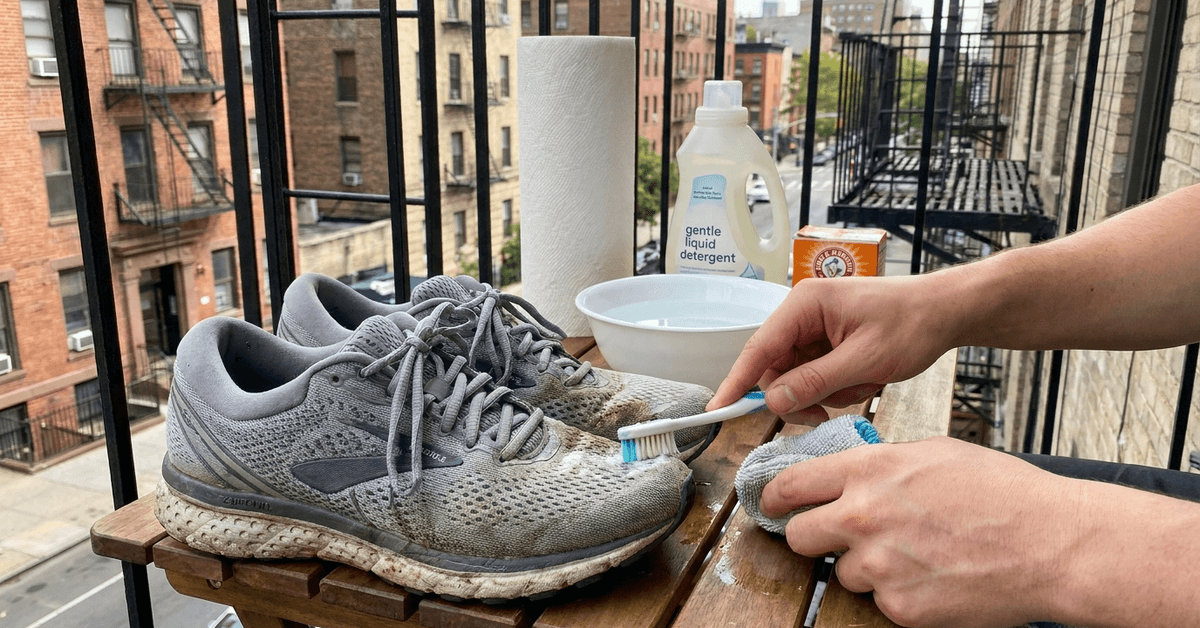
Dip a soft-bristled toothbrush into the solution and work in light, circular motions across stained areas.
The goal is to lift grime without pressing the bristles into the mesh hard enough to catch individual fibers. A microfiber cloth dampened in the same solution handles broader surface areas without snagging.
Drying Mesh Shoes Without Warping the Shape
The drying phase matters more than the washing phase for maintaining shoe shape. I’d put this at the top of any mesh care priority list after watching how quickly a $120 pair of Asics loses its structure from being left to dry empty on a radiator.
Stuff the shoes with paper towels or old t-shirts to hold the form while moisture wicks away. Place them in a well-ventilated spot: next to an open window or beneath a ceiling fan.
Sunlight fades colors. Heaters warp adhesive bonds between the sole and upper. Room temperature air and patience are the only safe combination, and drying usually takes 12 to 24 hours depending on humidity.
Mesh Shoe Cleaning Tools: What Works and What Wrecks
The right tools for cleaning mesh shoes are cheap. The wrong ones do permanent damage that no technique can reverse. A quick reference saves money and prevents repeated mistakes.
| Tool / Product | Safe for Mesh? | Reason |
|---|---|---|
| Soft-bristled toothbrush | Yes | Gentle enough to lift dirt without snagging fibers |
| Microfiber cloth | Yes | Distributes pressure evenly across the mesh surface |
| Mild dish soap / laundry detergent | Yes | Cuts grease without degrading fiber structure |
| Hard-bristled brush | No | Catches and pulls individual mesh threads apart |
| Bleach | No | Weakens fibers and strips color permanently |
| Washing machine | No | Drum impact deforms shoe shape and tears mesh |
| Clothes dryer | No | Heat shrinks mesh and dissolves adhesive bonds |
The safest cleaning kit costs under $10 total and includes a soft toothbrush, mild soap, a microfiber cloth, and a bowl of lukewarm water.
Crep Protect and Water-Repellent Sprays
A water-repellent spray applied between cleans helps mesh resist moisture and surface stains before they set. Crep Protect is one of the more popular options among urban sneaker communities.
Testing the spray on a small, hidden area of the shoe first is a smart move: some sprays leave a slight sheen or reduce breathability on certain mesh types.
Application works best on fully dry, freshly cleaned shoes. Spraying onto dirty or damp mesh locks grime into the fibers.
Getting Rid of Odor and Set-In Stains on Mesh Sneakers
City shoes absorb puddle water and food truck grease on a daily rotation. Odor and deep stains need a separate approach from standard surface cleaning, and the solutions are simpler than the sneaker cleaning industry wants anyone to believe.
The Baking Soda Fix for Shoe Odor
Baking soda absorbs odor without chemicals. Sprinkle it generously inside both shoes and leave it overnight. Shake out or vacuum the residue the next morning before wearing.
For stubborn stains, mix baking soda with a small amount of water to create a thick paste.
Dab the paste onto the stain, let it sit for about an hour, then brush it away gently with a dry, soft-bristled brush. A second pass may be needed for older stains that have bonded with the mesh fibers.
How Often Should City Commuters Clean Mesh Shoes?
Weekly spot-cleaning is the default recommendation across sneaker care guides and YouTube tutorials.
I’d argue that schedule causes more mesh fiber damage than it prevents, especially on engineered mesh from Nike and Adidas. Scrubbing mesh every seven days wears down the fiber weave faster than accumulated surface dirt does.
Monthly deep cleans, combined with a quick dry brush-off after particularly grimy commutes, put less mechanical stress on the material and still keep shoes presentable.
The exception is light-colored mesh. White or pastel mesh shows stains within days, and letting dirt sit for a full month can make those stains permanent.
But for darker mesh sneakers, which make up the bulk of city commuters’ rotation, a monthly cleaning schedule is enough.
Signs a Mesh Running Shoe Needs Replacing
Cleaning can only do so much. At a certain point, the shoe itself is done. The signals are usually obvious once you know what to look for:
- Persistent odor that returns within 24 hours of a full baking soda treatment
- Visible holes or loose threads in the mesh around the toe box or side panels
- Cushioning that feels flat or compressed, offering no bounce during walks or runs
- The sole separating from the upper, even slightly, along the heel or midfoot
Donation programs like Soles4Souls accept worn shoes and distribute them through networks in cities across the US and internationally. Berlin, Barcelona, and Chicago also run local sneaker recycling initiatives.
Protecting Mesh Shoes Between City Commutes
Cleaning matters, but what happens between cleans determines how long a pair of mesh sneakers lasts in a city rotation.
Storing shoes indoors, away from direct sunlight or apartment radiators, slows deterioration between wears.
Rotating between two pairs instead of wearing the same mesh sneakers every single day gives the material time to decompress and dry out naturally.
A quick dry brush-off after a rainy commute prevents mud from embedding into the weave overnight. That 30-second habit eliminates most of the surface grime that would otherwise require a full cleaning session later.
Shoe trees or balled-up socks stuffed inside overnight also help mesh hold its shape between wears, especially during humid months when the material absorbs ambient moisture.
Questions People Ask About Cleaning Mesh Running Shoes
These are the search queries and forum questions that keep coming up. A few of the answers add context not fully covered above.
- Q: Are sneaker cleaning kits worth buying for mesh shoes? A soft toothbrush, mild detergent, and a microfiber cloth do the same job as most $15 to $25 sneaker cleaning kits sold online. The kits are convenient, but the markup is steep for what amounts to a small brush and a bottle of diluted soap.
- Q: What is the fastest way to dry mesh sneakers? Stuffing shoes with absorbent material and placing them near airflow (an open window or ceiling fan) is the fastest safe method. Hair dryers and radiators speed up the process but risk warping the sole, melting adhesive, or shrinking the mesh permanently.
- Q: Can white mesh running shoes be restored to their original color? A paste of baking soda and water can lift most surface stains from white mesh when applied for 30 to 60 minutes. Heavily yellowed mesh from sun exposure or age is usually permanent, though, and no cleaning method fully reverses it.
Conclusion
Mesh running shoes survive city life much longer when cleaned gently with basic household tools. The biggest risk to mesh fabric is aggressive scrubbing, not the dirt itself sitting on the surface.
Monthly deep cleans protect the weave better than the commonly recommended weekly scrubbing sessions for darker sneakers. A $5 toothbrush and mild soap will stretch your favorite pair through several more months of commuting.