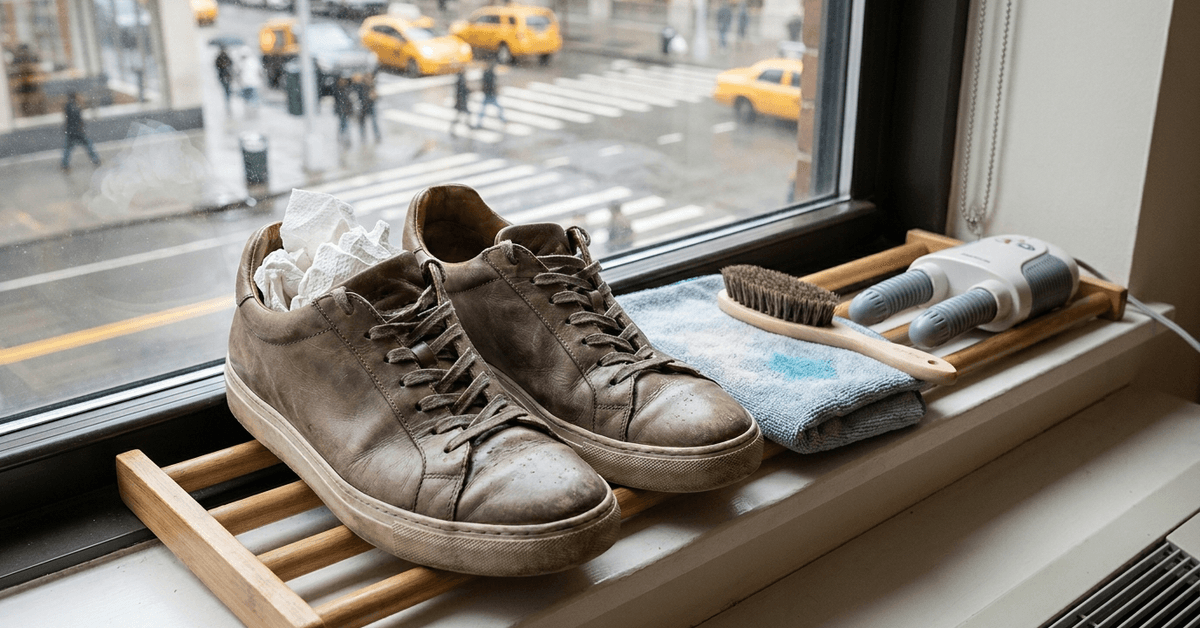
Mesh running shoes and a surprise rainstorm turn a $150 pair of sneakers into a soggy, shapeless mess in about ten seconds flat.
The instinct is always the same: blast them with heat, stuff them near a radiator, and hope for the best. That instinct wrecks more sneakers per year than actual wear and tear ever could.
Most sneaker drying advice online treats the problem like it’s universal. It isn’t. A pair drying on a Tokyo balcony in July behaves nothing like the same pair sitting by a window in Denver.
This one is for the urban commuter. The person who walks 20 blocks a day, owns two or three pairs in rotation, and refuses to let one bad rainstorm retire a shoe early.
Why Heat Destroys Sneakers Faster Than Rain Does
Rain itself is rarely the thing that kills a sneaker. The damage comes afterward, during the drying phase, when people reach for the fastest fix they can find.
The glue that bonds a sneaker’s sole to its upper starts softening at temperatures above 60°C (140°F). A standard hair dryer on its low setting sits right around that threshold. A radiator or space heater pushes well past it.
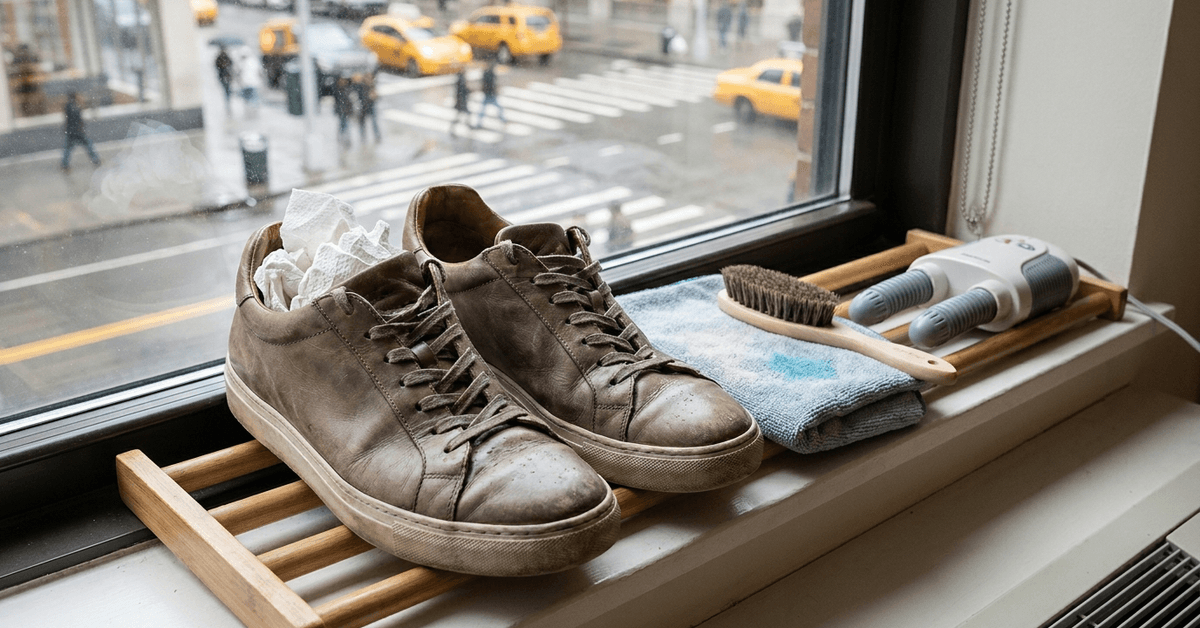
The sole separates from the upper, the midsole foam warps, and the shoe loses its structural fit permanently.
Warping, Shrinkage, and Sole Separation
Knit and mesh uppers are especially vulnerable. These materials contract when exposed to concentrated heat, pulling the shoe tighter across the toe box and changing the fit of the entire shoe. Once that shrinkage happens, there’s no reversing it.
Leather and synthetic leather respond differently but no better. Heat dries the oils out of leather, leaving it stiff and cracked. That white crease line across the toe of an old pair? Heat accelerated that.
Mold and That Smell That Never Leaves
Slow drying in a closed space creates a second problem: mold. Sneakers trapped inside a gym bag, a locker, or a closet with no airflow become breeding grounds within 24 to 48 hours.
The smell that sets in after mold starts growing is nearly impossible to remove completely. Baking soda and charcoal inserts can mask it, but the spores live in the foam.
I’d argue that mold damage is harder to fix than a worn-out sole, because at least a sole can be replaced at a cobbler for $30 to $50.
The Safest Way to Dry Wet Sneakers Step by Step
The method itself is simple. The discipline of following it instead of taking shortcuts is where people fall off.
Pull the Laces and Insoles Out First
Laces and insoles trap moisture between layers. Removing them lets air circulate through the entire shoe interior instead of just the opening.
Lay the insoles flat on a dry towel and hang the laces separately. Both dry significantly faster when they’re not compressed inside a wet shoe.
Blot, Stuff, and Swap
A microfiber towel works best for blotting. Press it against the upper and inside the shoe without wringing or twisting the material. Wringing stretches the upper and misaligns the shape.
After blotting, stuff the shoe with loosely crumpled paper towels or plain newsprint. The stuffing serves two purposes: it pulls moisture out of the interior, and it holds the shoe’s shape while the material dries.
Swap the stuffing every one to two hours, especially if the air is humid. Saturated paper stops absorbing and just sits there.
Now, about the stuffing material itself. Newspaper has been the default recommendation for decades, and I think that advice deserves a second look. Plain white paper towels absorb moisture at a comparable rate without the ink transfer risk.
I’ve seen enough ink-stained insoles on forums like r/Sneakers on Reddit to question why newspaper is still the first suggestion everywhere. Colored ink on a wet white knit upper is a stain that doesn’t come out.
Air Drying Placement Matters More Than People Realize
A well-ventilated spot is the single most important variable. A balcony, an open window, or a hallway with cross-ventilation all work.
Direct sunlight does not. UV exposure fades colors and weakens adhesive bonds over time. The exception is a pure white leather shoe that has no dye to fade, and even then, limit sun exposure to an hour or two at most.
A small desk fan pointed at the shoes from about a foot away speeds drying time by roughly half compared to still air alone. No heat required.
Dedicated Shoe Dryers Are Worth More Than the DIY Method
The standard advice says air dry, stuff with newspaper, be patient.
But I’d push back on the idea that a $40 shoe dryer is unnecessary when it consistently outperforms the newspaper method, particularly for anyone drying sneakers more than once a month.
Models like the PEET Original or the DryGuy DX Forced Air use low-temperature airflow to dry shoes in two to four hours without risking heat damage.
Compare that to the eight-to-twelve-hour wait with paper stuffing and a fan. The time difference alone is worth the price.
The practical benefit goes beyond speed. A shoe dryer applies consistent, even airflow through the entire interior.
Paper towels leave cold spots where moisture lingers, especially in the toe box and around the heel cup. Those cold spots are exactly where mold starts.
A shoe dryer makes the most sense for commuters, frequent travelers, and anyone rotating fewer than three pairs. If the sneaker gets wet on Monday night and needs to be worn Tuesday morning, air drying alone won’t cut it. A shoe dryer will.
| Drying Method | Approximate Dry Time | Risk of Damage | Best Suited For |
|---|---|---|---|
| Fan and paper towel stuffing | 8 to 12 hours | Very low | Daily routine, mild dampness |
| Dedicated shoe dryer (PEET, DryGuy) | 2 to 4 hours | Low | Frequent rain, travel, fast turnaround |
| Radiator or space heater | 1 to 2 hours | High | Not recommended |
| Direct sunlight | 3 to 5 hours | Moderate | White shoes only, limited use |
The sweet spot for most city commuters is owning a shoe dryer and keeping paper towels as backup for travel.
Your City’s Humidity Changes Everything About Drying
A drying technique that works perfectly in Los Angeles might completely fail in Manila or Singapore. Humidity is the variable that most sneaker care guides ignore, and it changes the math on every recommendation.
High-Humidity Cities Need Faster Extraction
Cities like Tokyo, New York, and Singapore sit above 70% average relative humidity during summer months. Paper towel stuffing in those conditions stays damp longer because the air itself can’t absorb much more moisture.
The swap-every-two-hours rule becomes swap-every-hour, and a fan becomes mandatory rather than optional.
A portable shoe dryer from PEET may be the only realistic option for anyone drying sneakers overnight in a humid apartment without central air conditioning.
Leaving shoes to air dry in a small Hong Kong or Manila apartment during monsoon season is an invitation for mold.
Dry Climates Give More Room for Patience
Cities like Madrid, Denver, and Phoenix make sneaker drying almost effortless. Low humidity means the air itself does most of the work. Paper stuffing, an open window, and four to six hours will handle most situations without a fan or a dryer tool.
The trade-off in dry climates is that leather dries too fast and cracks. A light application of leather conditioner after drying prevents that brittleness.
Prevention Gear That City Commuters Should Own
Drying sneakers correctly is half the equation. Keeping them dry in the first place takes a short list of inexpensive tools:
- Water-resistant spray like Crep Protect or Jason Markk Repel, reapplied every two to three weeks during rainy seasons
- A compact waterproof shoe bag (brands like Pack-It make foldable versions) for tossing in a backpack when rain is forecasted
- Spare socks in a zip-lock bag, because wet socks inside dry shoes recreate the same moisture problem
- A weather app set to hourly updates so the commute route and shoe choice can match the forecast
The prevention side costs less than $30 total and takes about five minutes of weekly maintenance. That’s cheaper than replacing one pair of ruined sneakers.
Quick mistakes to avoid on rainy commute days:
- Leaving wet sneakers sealed inside a backpack or locker overnight
- Using a washing machine’s spin cycle to “dry” sneakers (this destroys midsole foam)
- Stacking wet shoes on top of each other inside a drying rack
- Skipping the insole removal step because the shoes “aren’t that wet”
Questions People Ask About Drying Wet Sneakers
These are the questions that keep popping up in sneaker forums and city lifestyle threads. Quick answers, no fluff.
- Q: Can I put sneakers in the dryer on a low heat setting? A tumble dryer, even on low, generates enough heat to soften adhesive and warp midsole foam. The tumbling motion adds impact damage on top of the heat. Skip it entirely and use a fan instead.
- Q: How long does it take sneakers to air dry completely? The range depends almost entirely on humidity. Expect 8 to 12 hours in a humid environment and 4 to 6 hours in a dry one. A desk fan cuts those numbers roughly in half.
- Q: Does putting sneakers in rice work like it does for phones? Rice absorbs some surface moisture, but it doesn’t generate airflow inside the shoe. Grains also get stuck in mesh uppers and inside lace eyelets. Paper towels and moving air do the job better and leave less mess.
Conclusion
Drying wet sneakers the right way takes patience, but the payoff is a pair that keeps its shape and comfort for months longer.
The biggest mistake is reaching for heat, and the simplest fix is a fan and a stack of paper towels. City weather will always be unpredictable, so the habit matters more than any single product or trick.
Pick a method that fits the humidity where you live, and your sneakers will thank you for it.