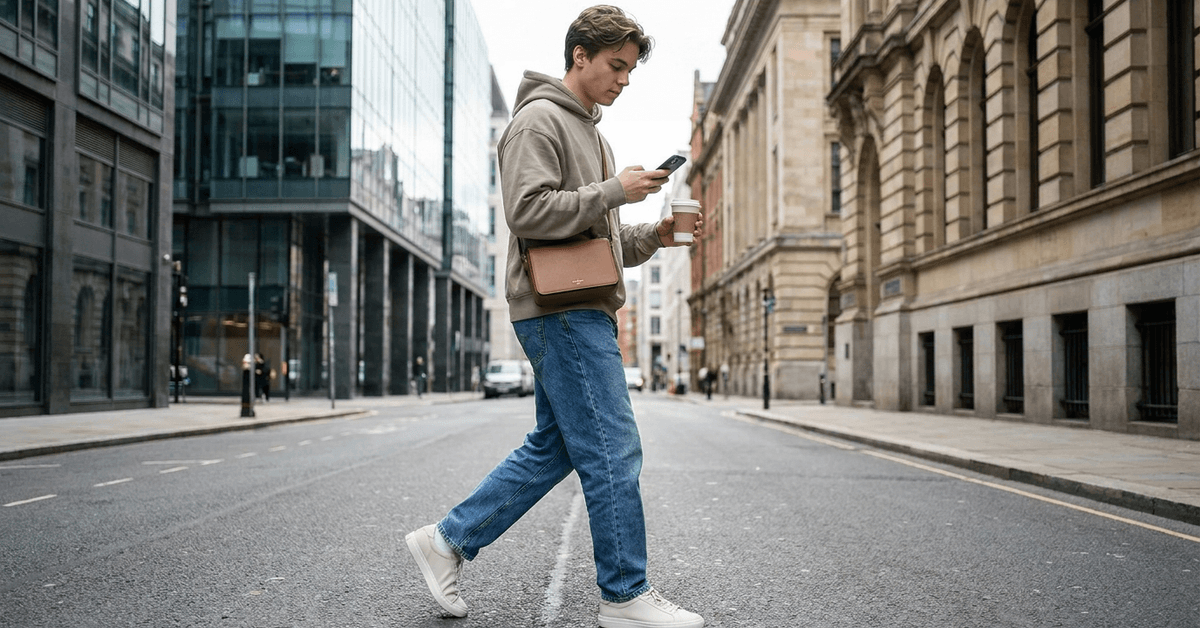
A pair of Balenciaga Track sneakers costs around $1,095. Lace them up with a $12 Uniqlo crew neck, and something strange happens. The sneakers don’t make the tee look better. The tee makes the sneakers look stolen.
That price gap is the first problem nobody in fashion circles wants to talk about. One luxury piece dropped into a cheap wardrobe creates a visual imbalance that screams “I saved for six months for these shoes and own nothing else.”
This article is for the city professional between 25 and 35 who earns enough to buy one or two designer pieces a year but can’t overhaul an entire closet. The person commuting through London or Berlin who wants to look intentional, not costumed.
The Single Statement Piece Trap
Every style guide repeats the same line: buy one luxury statement piece and build around it. A Gucci belt. A Burberry trench. A Louis Vuitton bag. Drop it into your existing wardrobe and watch it elevate everything.
I think that advice backfires for anyone shopping below the $200 price point for basics, and Acne Studios’ entry-level tees at $130 prove why. A single expensive item doesn’t pull cheap clothes upward.
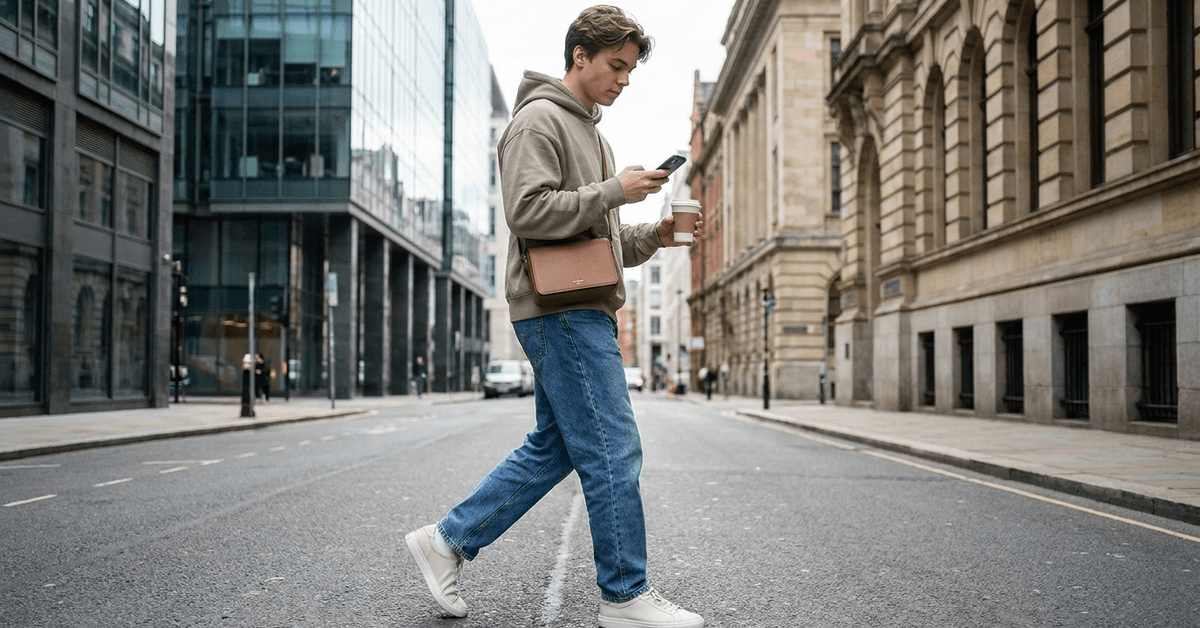
It pulls attention to itself and leaves everything else looking neglected. The eye travels to the logo, then scans the rest of the outfit, and the contrast creates a costume effect rather than a style.
The Ratio That Matters More Than the Price Tag
The split between luxury and streetwear in a single outfit matters more than how much any one item costs. A rough 30/70 ratio works well: 30% of the outfit’s visual weight comes from designer pieces, 70% from clean streetwear basics.
That keeps the luxury items feeling like punctuation, not a headline screaming over the rest of the sentence.
Flip that ratio and you get the Instagram influencer look: head-to-toe Gucci with one “relatable” hoodie thrown in. That reads as a brand advertisement. The 30/70 split reads as a person who happens to own nice things.
Start at the Bridge Brands, Not the Top
A smarter entry point sits in the space between pure streetwear and traditional luxury. Brands like Acne Studios, A.P.C., Ami Paris, and Axel Arigato price their pieces between $80 and $400.
They carry designer-level construction and fabric quality without the logo baggage of a Gucci or Louis Vuitton.
I would point anyone starting out toward Acne Studios denim at around $280 per pair or an Ami Paris wool overcoat before touching a Balenciaga anything.
Those bridge brands train your eye. They teach proportion, fit, and fabric quality at a price point where mistakes cost $200, not $1,100.
Pieces That Sit Between Both Worlds
The goal is building a mid-layer wardrobe that blends upward and downward without friction. A few categories do this better than others:
- Premium denim from Acne Studios or A.P.C. pairs equally well with a $20 Hanes tee and a $500 designer jacket
- Clean leather sneakers from Common Projects or Axel Arigato work across every dress code without screaming any brand name
- Unbranded wool overcoats in navy or camel read expensive regardless of their actual price, and Ami Paris makes these particularly well
- Minimal crossbody bags from smaller houses like Jacquemus give a designer signal without logo overload
Once this middle layer exists, dropping in a true luxury piece (a Cartier Tank watch, a Burberry scarf) feels natural instead of jarring.
Your City Should Dictate the Luxury-to-Streetwear Ratio
One thing I find missing from almost every style article on this topic: location changes everything about which combinations work.
An outfit that kills in Tokyo looks absurd walking through downtown Los Angeles. The city dictates the rules, and ignoring that context is how people end up looking like tourists in their own neighborhoods.
| City | Dominant Style | Luxury-to-Streetwear Ratio | Go-To Pairing |
|---|---|---|---|
| Paris | Understated monochrome | 40/60 | Trench coat + white sneakers + thrifted jeans |
| Tokyo | Layered, experimental | 25/75 | Tailored designer pants + oversized hoodie + quirky footwear |
| Los Angeles | Loud graphics, vintage | 20/80 | Retro Chanel accessories + Fear of God tee + distressed denim |
| London | Utility meets polish | 35/65 | Burberry scarf + cargo pants + statement rings |
| Berlin | Monochrome minimalism | 20/80 | Acne Studios basics + Reebok sneakers + no visible logos |
Berlin and LA lean heavily streetwear-dominant, so a single subtle luxury piece does the work. Paris and London tolerate a higher luxury ratio because the overall aesthetic already skews polished.
Reading the Room Where You Live
My take is that a $900 Gucci crossbody bag worn in Berlin’s Kreuzberg neighborhood signals the wrong thing entirely.
That same bag on the streets of Milan’s Brera district feels perfectly calibrated. The city’s baseline style determines what reads as “intentional” versus “trying too hard.”
Paying attention to what people on your daily commute wear tells you more than any fashion blog. Spend a week just noticing. Count logos. Look at silhouettes. That local data is more useful than any trend report.
Layering Is the Real Technique (Not Accessories)
Accessories get all the credit in most styling advice. Throw on a designer belt, add a luxury watch, done. But layering is where luxury and streetwear actually merge into one coherent outfit without either side dominating.
A well-structured layered outfit creates depth. Each visible layer contributes to the overall impression, and no single piece carries the entire burden.
Cities with unpredictable weather like Amsterdam and Copenhagen have turned this into a local art form.
Specific Layering Combinations That Work
Some of these pairings move between board meetings and bar stools without a wardrobe change:
- A luxury blazer over a clean cotton hoodie with dark denim. The blazer provides structure, the hoodie softens it, and the jeans anchor the look to streetwear
- An oversized cashmere sweater under a cropped streetwear bomber. The quality of the sweater shows at the collar and hem, and the bomber controls the silhouette
- Tailored wool trousers rolled slightly at the ankle over bold socks, paired with a graphic tee and a minimalist coat. The trousers do the heavy lifting while the tee keeps things casual
Each of these combos works because the proportions balance each other. Structured pieces tame voluminous ones. Fitted basics let a statement sneaker or bold boot grab attention without competition.
Rolling trouser hems to show a flash of designer socks or interesting footwear is a small move that adds personality without adding cost.
The One-Logo Rule for Brands and Visible Labels
Logo anxiety is real. Wearing a Louis Vuitton monogram bag with an Adidas-striped track jacket and a Nike swoosh cap creates visual noise. Three brands fighting for attention in one outfit turns a person into a walking sponsorship deal.
The fix is dead simple: one visible logo per outfit, maximum. Everything else stays unbranded or subtly marked.
A Louis Vuitton bag paired with logo-free Adidas Superstars and an unmarked crewneck lets the bag command the outfit without competition.
Smaller luxury brands work especially well here. A quiet Ami Paris logo on a sweater or an Acne Studios face patch on a beanie signals designer knowledge without the volume of a full monogram print.
Berlin residents have turned this into a local uniform: one small luxury detail buried inside otherwise anonymous streetwear.
Tools That Cut Down on Expensive Mistakes
A wardrobe app like Whering lets you photograph and catalog every piece you own, then plan outfits digitally before wearing them.
That sounds unnecessary until you realize how many $300+ purchases end up in closet purgatory because they don’t pair with anything already there.
Vestiaire Collective is worth checking for pre-owned luxury pieces at 40-60% below retail. The pre-owned market is a strategy, not a budget compromise. A gently used Cartier Tank watch or a secondhand Jacquemus bag carries the same visual weight as a brand-new version.
Farfetch tracks price drops on current-season designer items, and Pinterest boards dedicated to street style in your specific city give you a living mood board updated daily by real people wearing real clothes.
Mistakes That Drain Your Budget Fastest
A few patterns burn money without improving how outfits look:
- Buying luxury basics (a $400 plain white tee from Balenciaga, for instance) when the quality difference between that and a $30 alternative is invisible to everyone except the wearer
- Chasing seasonal trends from luxury houses instead of buying timeless silhouettes that work across years
- Purchasing luxury accessories that only match one outfit, leaving them unworn for months
- Ignoring care requirements: a hand-wash-only designer jacket worn during a rainy commute ages faster than a $60 weatherproof alternative
Questions People Ask About Mixing Luxury and Streetwear
A few searches pop up constantly on this topic, and most answers online barely scratch the surface.
- Q: How much should I spend on my first luxury piece for streetwear outfits?
Spending between $150 and $350 on a bridge brand like Acne Studios or A.P.C. makes more sense than jumping straight to $900+ designer items. That price range gives you designer-quality construction without the financial sting of a mismatch. - Q: Can I mix logos from competing brands like Nike and Adidas?
Technically, nothing stops you. But mixing two sportwear logos in one outfit usually reads as accidental rather than intentional. Stick to one athletic brand per outfit and let a non-competing luxury piece do the contrasting work. - Q: Do I need designer sneakers to pull off this look?
Not at all. Clean, minimal leather sneakers from Common Projects or even a well-maintained pair of white Air Force 1s work perfectly. The sneaker just needs to look intentional and cared for. - Q: Is buying pre-owned luxury pieces worth it for streetwear styling?
Absolutely, and for most pieces the condition difference is negligible after two wears. Pre-owned Jacquemus bags or vintage Chanel accessories carry the same visual weight and often have more character than brand-new equivalents. - Q: What is the biggest mistake people make mixing luxury and streetwear?
Overdoing the luxury ratio. Wearing three or four designer pieces at once cancels out the streetwear element entirely and leaves the outfit looking like a department store mannequin. One or two luxury items is the ceiling for most city outfits.
Conclusion
The smartest luxury-streetwear outfits treat designer pieces as quiet punctuation marks, not exclamation points. Bridge brands between the two worlds train your eye far better than jumping to the top shelf.
Every city has its own unwritten rules about how much polish feels natural versus performative. Spend a week watching your own neighborhood before spending a dollar on anything new.