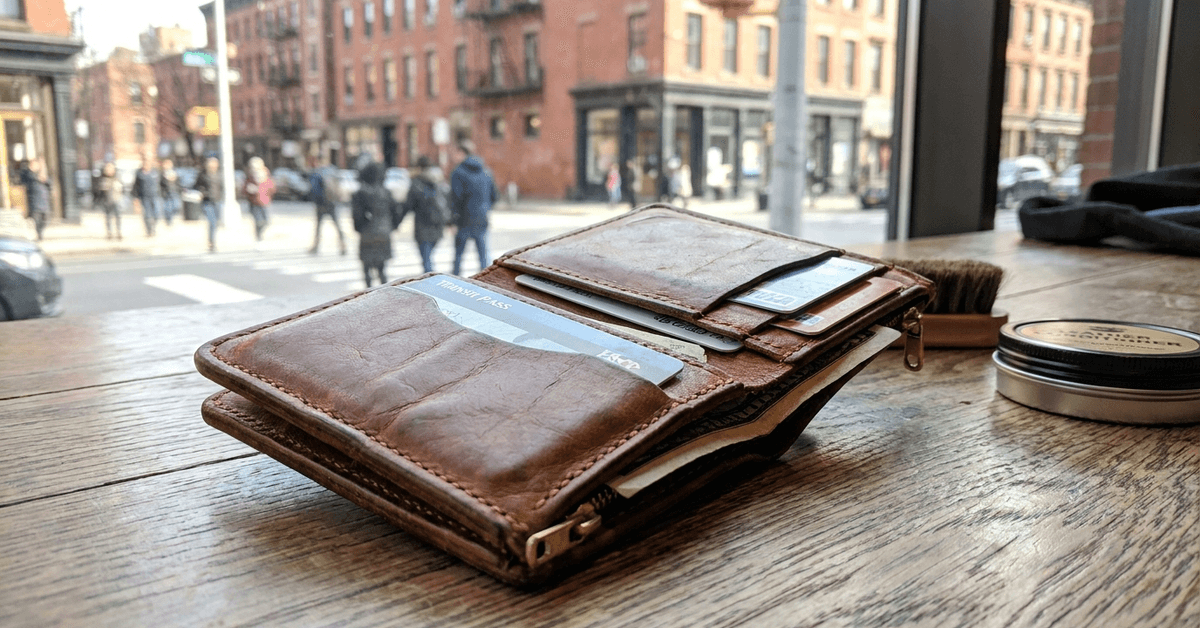
A label reading “genuine leather” sounds like a promise. It sounds like quality. That label is the lowest commercial grade of leather, made from reconstituted scraps that crack and peel within a year.
Most wallet guides rank products and skip the material science. The grade of leather, the lining behind card slots, and the type of stitching decide whether a wallet lasts twelve months or twelve years.
This piece is for urban commuters and city professionals who carry a wallet through subway turnstiles, café counters, and rainstorms. If the next wallet needs to survive real daily friction, the details below are the ones that matter.
Genuine Leather Means the Opposite of What It Sounds Like
The leather grading system is counterintuitive, and that confusion costs buyers money. Three labels appear most often on wallet tags and product listings: full-grain, top-grain, and genuine leather. They are not interchangeable.
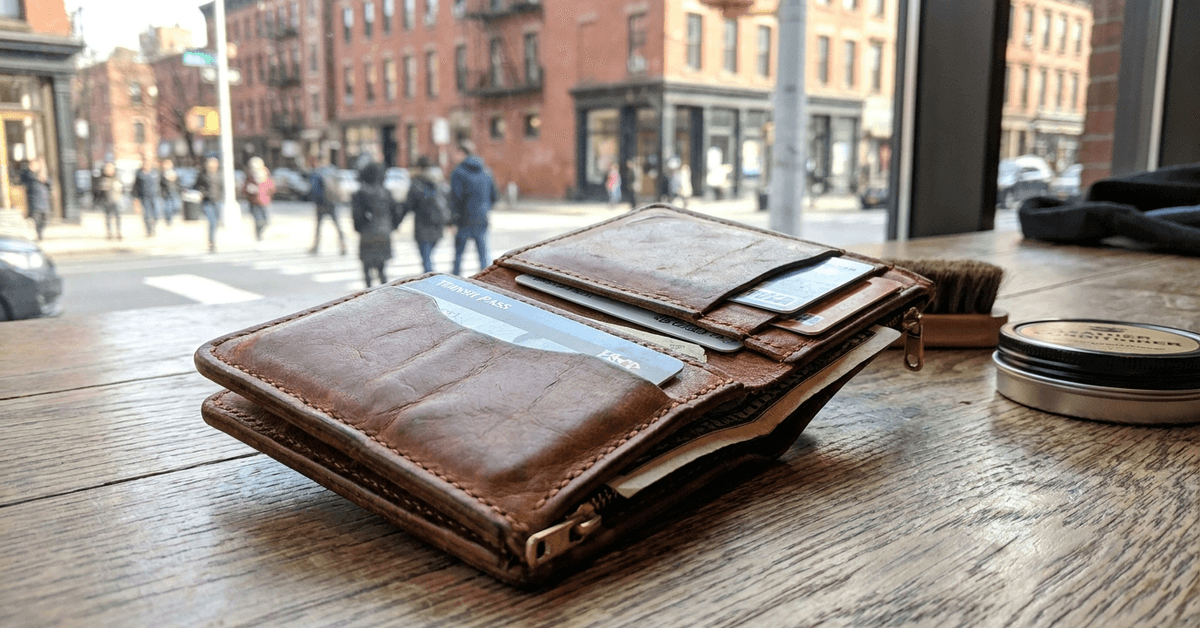
Full-grain leather keeps its natural surface intact. Scratches, pores, and grain marks remain visible. This is the highest grade, and it develops a patina over time: a soft luster that deepens with age.
A full-grain wallet bought today will look better in two years than the day it was purchased.
Top-grain leather is sanded and finished to create a smoother, more uniform look. It feels polished and is often used in mid-range wallets. But the sanding process removes the strongest fibers.
Top-grain wallets hold up reasonably well, though they rarely develop the same character as full-grain.
Genuine leather sits at the bottom. The term gets used as a marketing phrase, but it typically means split leather, reconstituted scraps, or the weakest layers of a hide. A wallet made from genuine leather looks fine on a shelf.
After six months of daily pocket carry, the edges curl, the surface flakes, and the whole thing starts looking tired.
Full-Grain Leather and How Patina Changes a Wallet
Patina is the gradual change in color and texture that happens through use. A dark brown full-grain bifold, after one year of subway rides, café stops, and rain, shifts toward a richer, warmer tone.
The leather softens without weakening. That transformation only happens with full-grain leather because the natural surface is still intact to absorb oils and friction from handling.
Lighter shades, like tan or cognac, tend to stain more easily in rainy climates. I’d lean toward dark brown or black full-grain leather for anyone commuting through London, Amsterdam, or Tokyo where wet weather is a constant factor.
Stitching, Linings, and the Construction Details That Decide Longevity
Leather grade gets all the attention. But a full-grain wallet stitched poorly will fall apart faster than a top-grain wallet built well. Construction quality is a separate question from material quality, and both need to pass inspection.
Saddle Stitching vs Machine Stitching
Saddle stitching uses two needles passing through the same holes from opposite sides. If one thread breaks, the other holds. Machine-only stitching runs a single thread in a chain. One break and the whole seam can unravel.
The easiest way to spot saddle stitching is to look at the thread angle: saddle-stitched seams show slightly angled stitches, alternating direction.
Run a finger along the seam near card slots and folds. Those are the highest-stress areas and the first places cheap stitching fails.
Lining Material Is a Better Quality Test Than Most Shoppers Realize
I was surprised by how much lining material matters for a wallet’s day-to-day feel. Cotton or high-end microfiber linings inside card pockets let moisture escape and keep cards sliding smoothly. Synthetic polyester linings, which are common in wallets under $50, trap heat and humidity against cards.
After a few months of daily commuting in warm cities like Singapore or Melbourne, that trapped moisture creates odor.
A wallet can have beautiful full-grain leather on the outside and still smell stale by summer because the lining is cheap polyester. Flip the wallet open and check the card pockets before buying. If the lining feels slick and plasticky, it is almost certainly synthetic.
Does a City Commuter Need a Minimalist Wallet?
The minimalist cardholder has become the default recommendation for urban professionals. And I get the appeal: slim profile, front-pocket carry, no bulk. Dense cities like Hong Kong, Berlin, and New York reward anything that saves space.
But I think the blanket advice to go minimalist is wrong for most city commuters, especially outside the US. Cities like Zurich, Milan, and Tokyo still run on coins for transit lockers, parking meters, and vending machines.
A cardholder with four slots and no coin pocket forces those coins loose in a jacket pocket, where they scratch phone screens and fall through seam holes.
My take: a slim bifold with a coin pocket covers more real situations than a pure cardholder. The wallet stays thin enough for front-pocket carry while handling the coins, receipts, and building access cards that city life produces daily. The minimalist aesthetic is borrowed from tech-culture preferences, not from how most world cities operate.
RFID Blocking and Quick-Access Card Slots
Some wallet features earn their space inside a city commuter’s pocket more than others:
- RFID-blocking layers reduce digital skimming risk in crowded transit hubs like Times Square or the Tokyo rail network
- Quick-access slots on the exterior let a commuter tap a transport card or building pass without opening the wallet
- Coin compartments with snap closures keep change contained in cities where coins remain part of daily transactions
- Slim profiles under 1.5cm fit front pockets comfortably for standing commutes
The first two matter most for daily speed. The last two matter for comfort over hours of carrying.
Testing Leather Quality at the Store or Online
Touching a wallet in person beats reading specs online. But most shoppers do not know what to feel for. Two quick tests take under ten seconds and reveal more than any product description.
The Pull-Up Effect and Flex Test
Press a clean fingertip gently against the leather surface. High-quality full-grain leather shows a momentary color change at the pressure point: the area lightens briefly, then returns to its original shade.
This is the pull-up effect, and it means the leather has natural oils distributed through its fibers. Synthetic blends and heavily coated leathers do not react this way.
The flex test is even simpler. Gently bend the wallet at the fold point. Quality leather creases smoothly and springs back. Poor leather cracks, showing white stress lines along the bend. If white lines appear after one flex, the wallet will crack badly within months of daily use.
| Feature | Full-Grain Leather | Top-Grain Leather | Genuine Leather |
|---|---|---|---|
| Surface | Natural grain, visible pores | Sanded smooth | Reconstituted, uniform |
| Durability | Decades | Several years | Under 1 year with daily use |
| Patina | Develops rich color over time | Minimal patina | None; surface degrades |
| Pull-Up Effect | Present | Sometimes | Absent |
| Price Range | Higher | Mid-range | Budget |
Full-grain costs more upfront, but per year of use, it is almost always cheaper than replacing genuine leather wallets annually.
Verifying Leather Authenticity with Apps
Shoppers can use tools like Entrupy for in-store leather verification through smartphone scanning.
Some brands also include QR codes on packaging that link to authenticity databases. These tools are most useful when buying from unfamiliar brands at pop-up markets or independent boutiques.
Leather Wallet Care for Urban Commuters
A good wallet still needs maintenance. The routine is minimal: ten minutes every couple of months makes the difference between a wallet that ages well and one that dries out and cracks.
A Quick Care Routine That Takes Five Minutes
A few habits keep leather in shape through years of city use:
- Wipe the exterior with a soft dry cloth once a week, especially after subway or bus commutes where grime accumulates
- Apply a natural leather conditioner every two to three months, more often in dry climates like Madrid or Melbourne
- Let a wet wallet dry flat at room temperature; never place it near a radiator or heater, because direct heat cracks leather fibers
- Empty the wallet weekly to remove receipts, expired cards, and anything adding unnecessary bulk
The Leather Working Group provides additional resources on care standards and sustainable sourcing for shoppers who want to verify a brand’s supply chain.
Avoiding Damage Specific to City Life
Contactless cards, house keys, and loose coins scratch wallet interiors faster than most people expect.
Alternating which pocket carries the wallet reduces wear on one side. Keeping keys in a separate pocket or pouch is the single easiest way to prevent interior scratching.
Spotting Low-Quality Wallets Before Buying
Even in well-known stores, shortcuts happen. A few red flags appear consistently in low-quality wallets:
- Overly smooth, plasticky texture: this usually means synthetic blends coated to mimic leather
- Unfinished or ragged-edge seams: these unravel within months of regular use
- Generic hardware with no brand markings: cheap zippers and snaps with rough movement suggest cost-cutting during production
- Strong chemical smell: over-treated or synthetic materials off-gas a sharp, plasticky odor that real leather does not produce
A wallet that passes the pull-up test, has saddle stitching, and uses cotton linings will almost always outlast one that fails any of those checks.
Price alone does not guarantee quality, but the combination of these three signals does correlate strongly with durability.
Questions People Ask About Leather Wallets for City Life
These are common questions that come up when shopping for a long-lasting wallet in an urban setting.
- Q: How long should a full-grain leather wallet last?
A full-grain leather wallet with proper care can last a decade or longer. The leather itself rarely fails; stitching and lining wear are the first things to go. Checking seam quality at purchase prevents most early failures. - Q: Is RFID blocking in wallets worth paying extra for?
RFID skimming in crowded transit systems is a low-probability risk, but the protection adds almost no bulk or cost to a well-made wallet. If a wallet already has the construction quality and materials right, RFID blocking is a reasonable bonus rather than a deciding factor. - Q: Can a leather wallet be repaired instead of replaced?
Many small-batch leather makers and cobblers offer re-stitching and edge refinishing for well-made wallets. Asking about repair policies at the time of purchase gives a clue about the maker’s confidence in their own product. - Q: Does wallet color affect how fast patina develops?
Darker leathers show patina more subtly, while lighter colors like tan or natural develop visible character faster. Lighter shades also show stains more readily, so city commuters in rainy climates often gravitate toward darker tones. - Q: Are online leather wallets as reliable as in-store purchases?
Buying online removes the ability to perform touch and flex tests before purchasing. Platforms that offer free returns and detailed close-up photos of stitching reduce the risk. Artisan marketplaces and direct-from-maker websites tend to provide more material transparency than large retail aggregators.
Conclusion
The right leather wallet for city life starts with full-grain leather and saddle stitching as a baseline. Lining material and construction matter as much as the leather itself for daily durability.
A slim bifold often outperforms a minimalist cardholder once coins and access cards enter the mix. Check the pull-up effect, smell the leather, inspect the seams, and the wallet will earn its price over years of commuting.