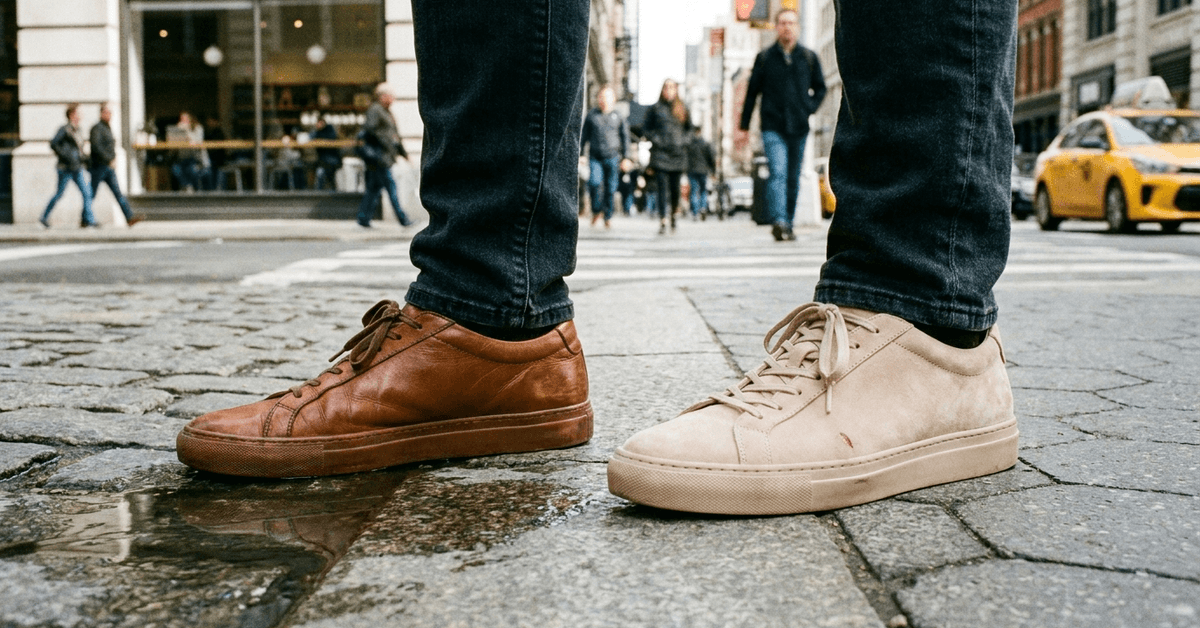
Nubuck sneakers look incredible on the shelf. They also look terrible after two weeks of daily subway commutes and sidewalk puddles, and most sneaker guides gloss over that part.
The care routines for leather and nubuck are so different that treating them the same way ruins one pair fast. A microfiber cloth saves leather. That same cloth can flatten nubuck’s texture permanently.
This guide is for the person logging serious mileage on city pavement: the daily walker, the train commuter, the person whose sneakers earn every scuff. If that sounds like your week, the material on your feet changes how much time and money you spend keeping them alive.
Leather and Nubuck Start From the Same Hide, Then Split Hard
Both materials begin as animal hide. The similarity ends there, and the split matters for anyone buying sneakers that need to survive asphalt.
Full-grain leather goes through a tanning process that leaves the surface smooth and somewhat resistant to moisture. It develops a patina over time, and minor scratches blend into that patina rather than standing out.
Top-grain leather gets a light sanding and a finish coat, giving it a softer hand but slightly less toughness than full-grain.
How Nubuck Gets Its Texture
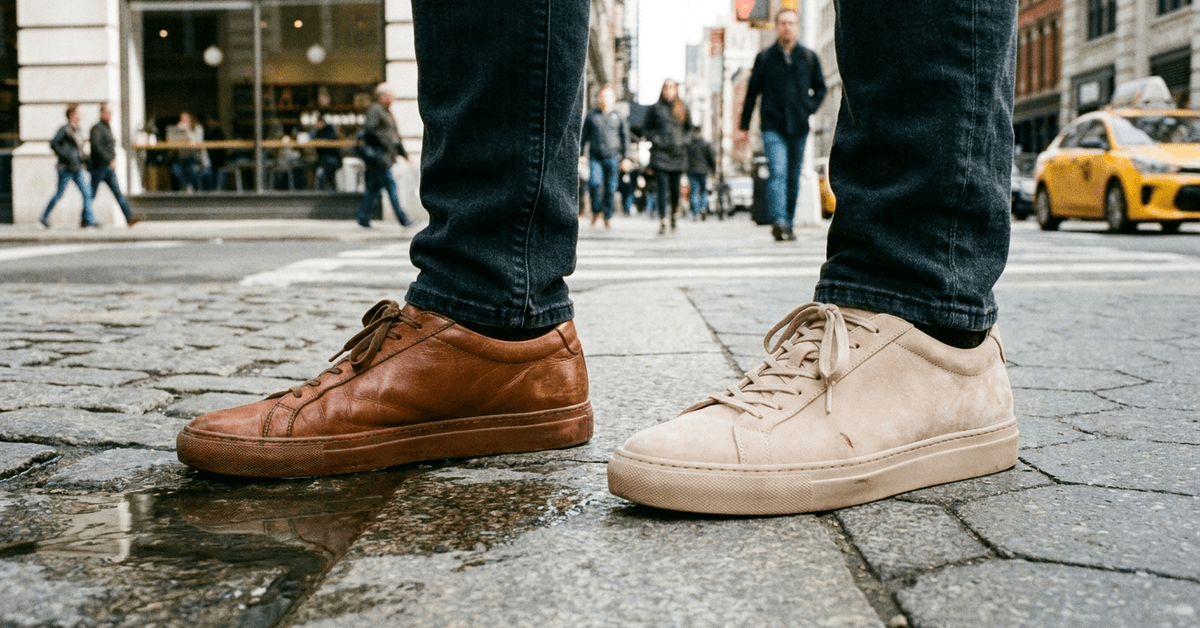
Nubuck takes full-grain leather and sands the outer surface until it develops a soft, velvety nap. That nap is what makes nubuck look expensive. It is also what makes nubuck a magnet for water spots, oil stains, and street grime.
The sanding removes the natural protective layer that smooth leather keeps. So nubuck feels softer, but it absorbs liquids instead of repelling them. A coffee spill on leather wipes off. The same spill on nubuck soaks in within seconds.
Cleaning Leather Sneakers on a City Schedule
Leather care fits into a busy routine because the steps are quick and the margin for error is wide. Mess up a little and the shoe forgives you.
The Daily Wipe-Down That Takes 30 Seconds
After a day on city streets, a dry microfiber cloth removes surface dust and light grime. For tougher spots, a slightly damp cloth with a small drop of mild soap does the job.
Let the sneakers air dry away from direct heat or sunlight, since heat warps leather and sunlight fades the color. Once a month, apply a leather conditioner. This keeps the material flexible and prevents cracking along the toe crease and heel cup.
That crease is where most leather sneakers die: the leather dries out, cracks form, and the shoe looks ten years older overnight.
Weatherproofing Leather for Rain and Slush
A thin coat of waterproofing spray every few weeks adds a barrier against rain, puddles, and winter salt.
Cities like Toronto and Stockholm punish sneakers with road salt from November through March. That salt leaves white tide marks on untreated leather.
I would pick a silicone-based spray over a wax-based one for leather sneakers because silicone doesn’t change the shoe’s color or finish. Wax sprays can darken lighter leather and leave a sticky residue if over-applied.
Nubuck Care Is a Completely Different Job
Leather care is forgiving. Nubuck care is not. The tools are different, the process is slower, and mistakes leave permanent marks.
The Brush-and-Eraser Method
Nubuck cannot be wiped with a damp cloth. Moisture is the enemy. The correct routine starts with letting any dirt or mud dry completely, then using a nubuck brush to sweep away surface dust. Always brush in one direction to keep the nap uniform.
For scuff marks and light stains, a nubuck eraser works like a pencil eraser on paper. Gentle pressure lifts the stain without flattening the texture.
Too much pressure, though, and the nap goes smooth in that spot. That smooth patch never matches the rest of the shoe.
Heavier stains need a specialty nubuck cleaner. Spot-test on a hidden area first, because some cleaners darken certain nubuck colors. This is the kind of detail that separates a saved pair from a ruined one.
Nubuck and Rain: A Bad Combination
A single rain shower can leave watermarks on unprotected nubuck. A dedicated nubuck protector spray is mandatory for city wear.
Two coats work better than one, but each coat needs to dry fully before the next goes on. Rushing this step leaves the spray uneven and creates blotchy patches.
I think the common recommendation to wear nubuck sneakers daily in a city misses a basic math problem: the spray needs reapplying every two weeks, and each application takes 20 to 30 minutes of drying time between coats.
That is a lot of maintenance for a shoe you could replace with leather and skip entirely.
The Real Cost Difference Over 12 Months
Price tags only tell part of the story. The purchase price gap between leather and nubuck sneakers is often small. The ownership cost gap is not.
| Cost Factor | Leather Sneakers | Nubuck Sneakers |
|---|---|---|
| Cleaning tools | Microfiber cloth, mild soap | Nubuck brush, nubuck eraser, specialty cleaner |
| Protection products | Waterproofing spray (general) | Nubuck-specific protector spray |
| Professional cleaning frequency | Rarely needed | Multiple times per year for heavy wear |
| Replacement timeline | Longer with basic care | Shorter if maintenance lapses |
Leather’s total cost of ownership stays low because the products are cheap and widely available. Nubuck’s specialty products cost more per unit and run out faster.
Who Should Still Pick Nubuck
Nubuck makes sense as a second-rotation sneaker for evenings, weekends, and dry-weather days.
The texture and color depth are hard to match. Cities like Milan and Berlin have sneaker cultures where nubuck is a style signal, and that has real social value.
But as a daily commuter shoe? Leather handles that role with less fuss and a longer lifespan. The sneaker you wear five days a week should be the one that survives five days a week without a 30-minute care ritual.
Storage and Repair in Small City Apartments
Most sneaker care guides assume you have a mudroom or a spacious closet. City apartments rarely offer either. A 400-square-foot studio needs storage solutions that work in tight spaces.
Keeping Leather Sneakers in Shape
Shoe trees (cedar ones absorb moisture and odor) keep leather sneakers from developing deep creases during off days.
After a long walk, let the shoes air out in a shaded spot before putting them away. Rotating between two pairs extends both their lifespans because each pair gets time to fully dry.
A common mistake: storing leather sneakers in plastic bins or sealed bags. Leather needs airflow. Sealed storage traps moisture and can cause mildew, especially in humid apartments.
Nubuck Storage Rules
Nubuck sneakers need dark, dry storage because sunlight fades the color faster than it fades leather.
Tossing moisture-absorbing silica packets into the shoe helps prevent mold in humid climates. Stuff the shoes with unscented paper overnight to wick moisture from the interior lining.
Avoid stacking anything on top of nubuck sneakers. Pressure flattens the nap, and a flattened nap on a stored shoe may not brush back to its original texture.
Quick Fixes for City Scuffs
Leather scuffs respond well to leather repair cream matched to the shoe’s color. A polish restores surface sheen in minutes.
Some sneaker repair services like SneakersER handle deeper damage, including sole regluing and color restoration, through mail-in service.
Nubuck repairs are trickier. A fine sanding block can sometimes revive a scuffed patch, but applying too much pressure creates a smooth spot that never blends back.
Professional cleaning is a better bet for deep stains or color loss. The Saphir nubuck care line is one of the more reliable product ranges for at-home nubuck restoration.
Picking the Right Sneaker Material for Daily City Commutes
The decision comes down to how much maintenance time fits into a weekly routine. A few things to check before buying:
- Climate matters more than style. A city with frequent rain (London, Seattle, Amsterdam) punishes nubuck harder than a dry-climate city like Madrid or Phoenix.
- Commute length changes the math. A 10-minute walk to the office is kinder to nubuck than a 45-minute multi-transfer commute with standing-room-only trains.
- Repair access varies by city. Check if local sneaker shops handle nubuck-specific cleaning. Not all of them do, and mailing shoes for professional service adds time and cost.
- Rotation extends life for both materials. Owning two pairs and alternating days lets each pair dry and rest, which matters more in humid cities like Singapore or Houston.
The best answer for most daily commuters is leather as the workhorse and nubuck as the dress-up pair. That split keeps maintenance manageable and gives both materials the conditions where they perform best.
Questions People Ask About Leather vs Nubuck Sneaker Care
These are the questions that keep popping up around this topic, and the answers go a bit deeper than the usual surface-level takes.
- Q: Can I use the same waterproofing spray on leather and nubuck? No. Silicone-based sprays work for leather, but nubuck needs a spray formulated for its textured surface. Using a leather spray on nubuck can clog the nap and create a waxy feel that ruins the look.
- Q: How often should I condition leather sneakers if I walk a lot? Once a month is a good baseline for heavy walkers. Conditioning too often can over-soften the leather and weaken its structure, so more is not better here. Check for dryness along the toe crease as your signal.
- Q: Is nubuck worth it if I live in a rainy city? It can be, but only as a rotation shoe for dry days. As a daily pair in a city like London or Vancouver, the watermark risk and constant respraying make it a frustrating choice. Save nubuck for controlled-weather outings.
Conclusion
The sneaker on your feet right now is either thanking you for the care or quietly falling apart. Leather gives urban commuters a low-maintenance path to long-lasting shoes that handle city grit.
Nubuck rewards patience and careful rotation, but punishes daily neglect faster than most buyers expect. Knowing which material fits your routine is the difference between sneakers that last years and ones that last months.