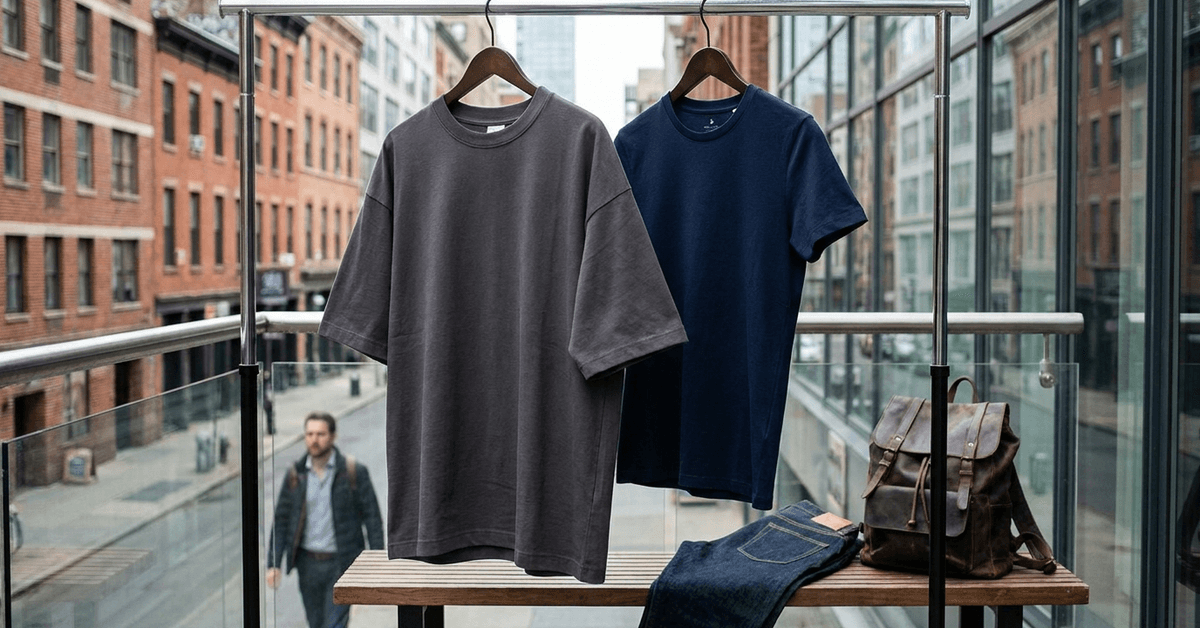
A slim fit t-shirt looks perfect on the hanger. It looks perfect under store lighting with your shoulders pulled back and your gut sucked in for three seconds. Then you sit on a train for forty minutes and spend the rest of the day pulling the hem down.
That fitting-room-to-real-life gap is where most t-shirt advice falls apart. Guides rank fits by body type, but body type tells you almost nothing about how a shirt performs across eight hours of commuting, sitting, eating, and walking.
This one is for the city commuter who buys online, wears the same rotation of five tees all season, and keeps getting stuck between “boxy” and “slim” filters without a clear reason to pick either.
Slim Fit T-Shirts Get the Default Recommendation: Does That Hold Up?
Slim fit has been the safe pick in menswear advice for over a decade. The logic sounds clean: a shirt that follows your body’s lines looks intentional, polished, and less sloppy than anything loose.
Stylists in London and Milan have repeated this long enough that it became a reflex.
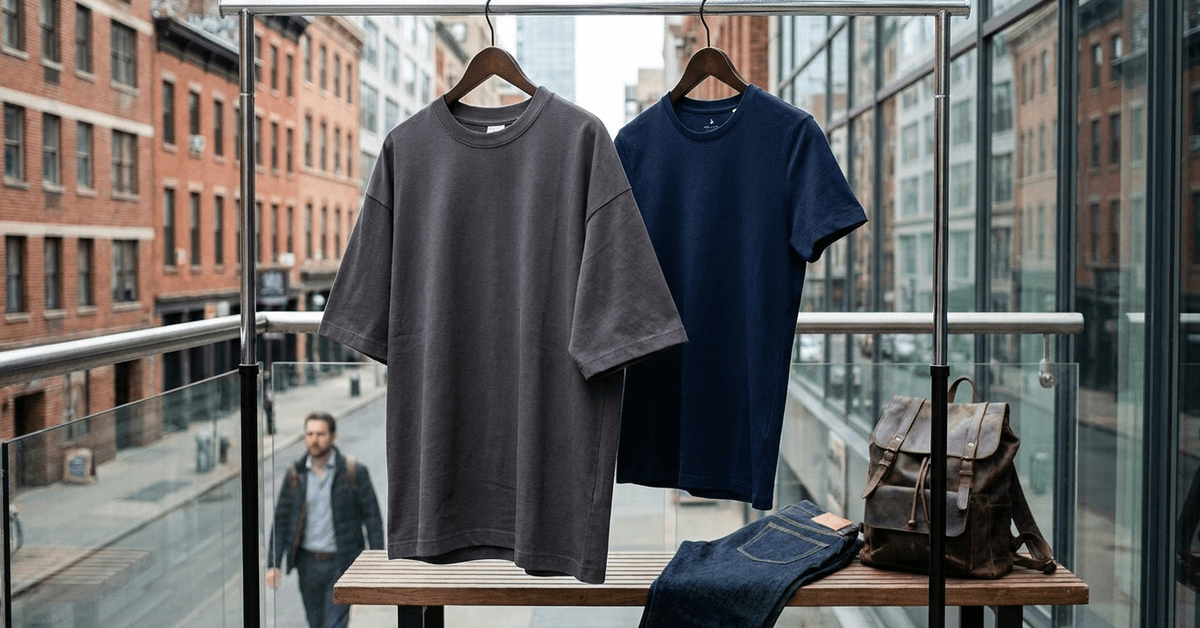
But slim fit carries a hidden assumption. It assumes your day involves standing, walking, and sitting upright at a desk.
The moment your routine includes cycling, carrying a bag across one shoulder, or eating a large lunch, slim fit starts working against you. The taper through the torso restricts airflow.
The shorter hem rides up when you lift your arms. And if you gain or lose even two kilos across a season, the shirt moves from “fitted” to “tight” overnight.
When Slim Fit Still Makes Sense
I’d still pick slim fit for one specific scenario: layering under a tailored jacket. A fitted tee under a blazer sits flat against the chest and avoids bunching at the waist.
That makes it the right choice for office settings where a t-shirt needs to pass as a base layer, not the main event. Slim fit also works on leaner frames that don’t carry much width through the midsection.
If your shoulders and hips are close to the same width, a tapered cut follows the body without pinching. But the second your proportions shift even slightly, the shirt becomes unforgiving.
Boxy Fit T-Shirts and the Comfort Equation
A boxy cut runs wider from shoulder to hem, usually with a straight or slightly dropped shoulder seam. The silhouette sits away from the body rather than clinging to it.
Some boxy tees have a slightly cropped hem, which creates a structured look rather than a baggy one.
The appeal in cities like Seoul, Tokyo, and Berlin has been growing for years. Streetwear made boxy cool, but the real driver is practical: boxy cuts breathe better, hide sweat patches, and survive a full day of movement without losing shape.
For anyone commuting by bike or spending hours on their feet, that airflow gap between boxy and slim is noticeable by midday.
Layering Boxy Tees Across Seasons
A boxy tee layered over a long-sleeve thermal works in colder months without adding bulk the way a slim fit would. The extra width in the torso means you can slide a thin base layer underneath and still look intentional.
Summer is where boxy really earns its keep. Looser fabric away from the skin dries faster and traps less body heat. Anyone who has peeled a damp slim fit off their back after a July commute knows this feeling.
Fabric Weight Changes Everything the Fit Label Doesn’t Tell You
Most fit guides stop at the cut: slim or boxy, and move on. Almost none mention fabric weight, measured in GSM (grams per square meter). This single variable changes how any cut sits on the body.
A boxy tee made from lightweight jersey at 130 GSM will cling and wrinkle, looking shapeless rather than structured.
That same boxy pattern cut in 200+ GSM heavyweight cotton holds its box shape, drapes cleanly, and moves like a different shirt entirely.
Brands like Uniqlo’s U line have built entire sub-collections around heavyweight boxy tees for exactly this reason.
How GSM Shifts the Drape on Slim Fits Too
Slim fit has the opposite problem. A slim tee in heavyweight cotton can feel stiff and restrictive, almost like wearing a compression shirt. Lightweight slim fits (140-160 GSM) tend to drape better against the body and flex when you move.
I think the biggest mistake buyers make on ASOS or Zalando is filtering by fit without checking fabric composition or weight.
A “boxy” tee in thin polyester blend will look nothing like the model photo. A “slim” tee in thick organic cotton will feel nothing like the product description suggests.
So the question worth asking before every purchase: what is the GSM, and what is the fabric blend? These two details predict how the shirt drapes on your body more accurately than the fit label alone.
How to Check T-Shirt Fit Before Buying
Testing fit takes about thirty seconds if you know what to look for. Most people skip these checks and end up with a drawer full of shirts they wear once.
Fitting Room Moves That Expose Bad Fit
A mirror pose tells you nothing. The real test is movement. Try these:
- Lift both arms overhead and check if the hem rises above your belt line. If it does on a slim fit, it will ride up every time you reach for a shelf or grab a subway handle.
- Twist your torso left and right. A slim fit that bunches at the side seam will do that all day. A boxy fit that balloons outward when you twist has too much excess fabric.
- Sit down in the fitting room chair. Slim fits that feel fine standing can dig into the armpits or bunch at the belly when seated. This is where half of all slim fit complaints come from.
Buying T-Shirts Online Without Guessing
Online returns are easy through platforms like ASOS and Zalando, but a smarter approach saves time:
- Order the same shirt in two sizes if the brand is new to you. Return the one that doesn’t work. Most EU-based retailers offer free returns within 14-30 days.
- Check the product page for a size chart with chest, length, and shoulder measurements in centimeters. Compare these to a shirt you already own and like.
- Read reviews that mention the reviewer’s height and weight. A five-star review from someone with a completely different frame tells you nothing about how it will fit you.
Boxy vs Slim Fit T-Shirt Comparison
| Feature | Boxy Fit | Slim Fit |
|---|---|---|
| Silhouette | Straight, wider through torso | Tapered, follows body contour |
| Mobility | High: arms and torso move freely | Moderate: restricted when lifting arms |
| Layering | Easy over thermals, long sleeves | Best under blazers and tailored jackets |
| Summer Comfort | Cooler, fabric sits off skin | Warmer, traps body heat |
| Body Type Flexibility | Forgiving across weight changes | Sensitive to 1-2 kg fluctuations |
| Street Style Fit | Seoul, Tokyo, Berlin trends | Milan, Paris, London trends |
The biggest takeaway: boxy suits movement-heavy days, slim suits presentation-heavy ones.
Questions People Ask About Boxy vs Slim Fit T-Shirts
These come up constantly when people search for t-shirt fit advice, and the answers tend to be more nuanced than a simple “it depends.”
- Q: Can a boxy t-shirt look professional? Absolutely, if the fabric weight is high enough (180 GSM or above) and the color is solid. A heavyweight white boxy tee under a structured overcoat reads clean and intentional. The trick is avoiding thin, wrinkly fabrics that make boxy look like “borrowed from someone bigger.”
- Q: Is boxy fit the same as oversized? No. Boxy means the cut is wider but the length stays proportional. Oversized means both width and length are scaled up, often dropping below the hip. A properly cut boxy tee hits at the belt line or slightly above, while an oversized tee hangs much lower.
- Q: How do I know if a brand’s “slim fit” runs true to size? The only reliable method is checking the brand’s size chart and comparing actual measurements to a shirt you own. “Slim fit” has no standard definition across brands. A slim fit at H&M and a slim fit at COS can differ by 5+ cm in the chest.
Conclusion
The t-shirt fit debate gets overcomplicated by body-type charts that ignore how people spend their day. A shirt that breathes through a bike commute and survives a long seated meeting beats one that only looks sharp for the first twenty minutes.
Fabric weight and daily movement patterns should drive the decision more than shoulder width or waist size. Pick the cut that works for your Tuesday, not your mirror selfie.