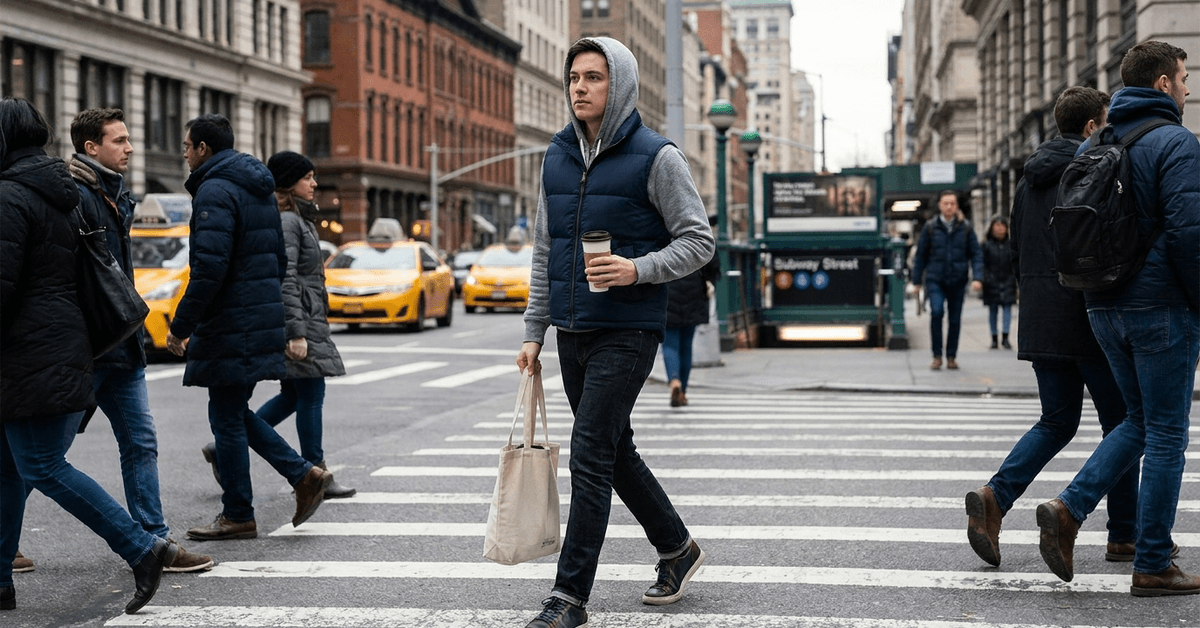
A puffer vest over a hoodie should look effortless. Most of the time, it looks like a sleeping bag ate your torso.
The problem is rarely the vest itself. It’s the mismatch between what goes underneath and how the vest sits on top of it, a detail that every “best puffer vests” roundup skips entirely.
This one is for daily commuters and transit riders in their 20s and 30s who walk, bike, or squeeze onto packed trains. People who need a layering system that performs between 7 AM and 10 PM without looking like they forgot to take their jacket off.
The Fit Problem Starts Under the Vest, Not on Top of It
Most puffer vest guides start with which vest to buy. I’d argue that’s the wrong order entirely. The garment underneath the vest determines 80% of how the outfit looks and feels, and that’s where most people get it wrong.
Hoodie Thickness Changes Everything
A heavyweight cotton hoodie under a slim-profile puffer vest creates bunching around the shoulders and armpits. The sleeves twist. The collar folds awkwardly.
And the whole silhouette balloons outward, making you look like you’re wearing someone else’s clothes.
Medium-weight cotton hoodies work better under vests because the fabric has enough structure to hold its shape but not enough bulk to fight the vest for space.
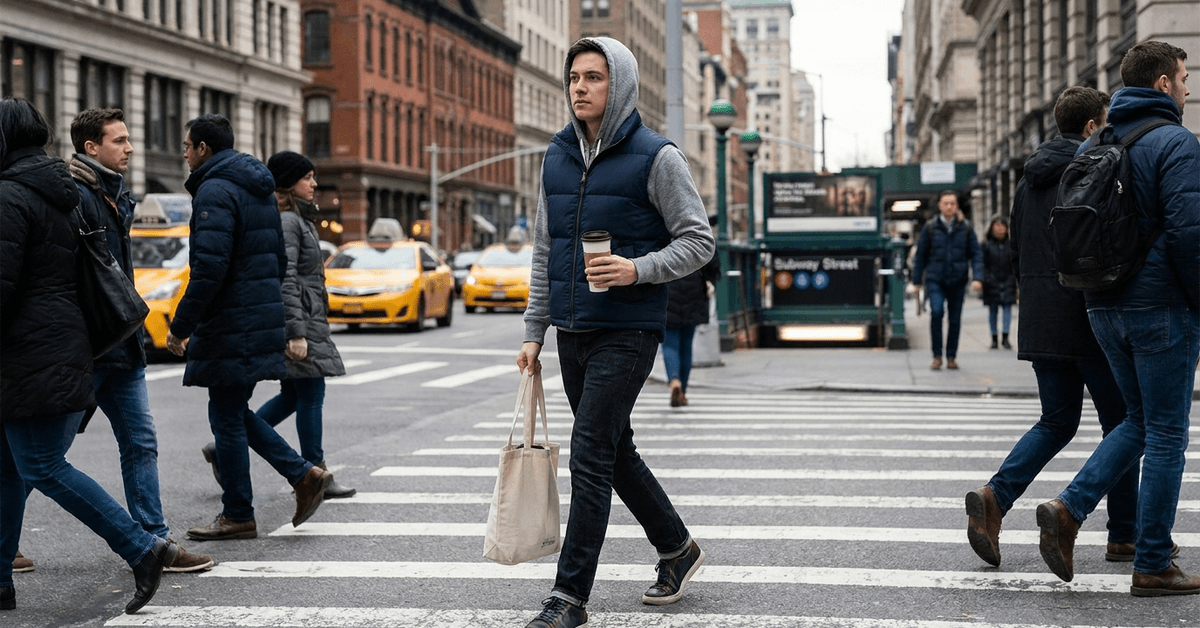
Fitted cuts sit flatter against the body. The hood can drape naturally behind the collar or tuck under depending on the look.
I would pick a mid-weight fitted hoodie over a premium heavyweight one for vest layering every time, specifically because brands like Uniqlo price their lightweight options between $20 and $40 and the proportions stay clean all day.
Sweaters That Slide vs. Sweaters That Bunch
Not every knit plays nice under a puffer vest. Chunky hand-knit sweaters, the kind with thick cable patterns and textured yarn, create lumps and pressure points under a quilted vest. The two layers compete instead of cooperating.
Merino wool and cashmere blends slide under a puffer vest without resistance. The fabric is thin enough to layer flat but warm enough to justify the combination.
Crewneck and turtleneck cuts work better than V-necks here because the higher neckline fills the collar gap that most vests leave exposed.
Pair a slim turtleneck under a matte-finish vest with skinny jeans and leather loafers, and the outfit shifts from weekend-casual to something appropriate for a gallery opening or rooftop bar.
A Step-by-Step Layering Order That Prevents the Bunchy Look
Getting the layers right is a sequence problem. The order matters, and so does how each piece sits before you add the next one.
Start with a fitted base layer: a basic tee or a thermal, depending on temperature. This sits flat against the skin and prevents the hoodie or sweater from sticking.
Pull on the hoodie or sweater next, smoothing the sleeves so they sit flat from shoulder to wrist. Twisted sleeves under a vest are one of the fastest ways to make an outfit look careless.
Add the puffer vest last, adjusting the collar so the layer underneath is visible. If wearing a hoodie, letting the hood hang out behind the vest collar creates a relaxed silhouette. Tucking it in cleans up the profile for dressier settings.
A lightweight scarf or beanie can add a final layer on cold mornings without adding bulk. Both compress into vest pockets when temperatures climb later in the day.
Picking a Puffer Vest for City Weather
Climate dictates vest choice more than personal style does. A vest that works for October in Berlin won’t perform the same way during January in Montreal, and the wrong pick creates either overheating on transit or freezing between stops.
Wet Cities Need a Water-Resistant Shell
Rain-heavy cities like Seattle, London, and Vancouver demand a vest with a water-resistant outer shell. A standard nylon puffer vest will soak through in light drizzle and take hours to dry, which defeats the point of wearing it during a commute.
Quick-drying materials make a real difference for people who bike or walk in wet conditions. A soaked vest on a packed bus is uncomfortable for everyone involved.
Cold Cities Need More Fill, Not More Layers
I think the instinct to pile on extra layers in cold cities like Montreal or Toronto is a mistake when a higher-fill-power vest would solve the problem with a single garment.
Down-filled vests with 600+ fill power trap more heat per ounce than synthetic alternatives, meaning the vest can be thinner while keeping the same warmth.
Pairing a high-fill vest with a medium-weight hoodie covers most urban winter conditions between 0°C and 10°C without the restricted movement that comes from stacking three or four layers.
| Feature | Wet City Vest (Seattle, London) | Cold City Vest (Montreal, Toronto) |
|---|---|---|
| Shell Material | Water-resistant nylon or polyester | Standard nylon, windproof preferred |
| Fill Type | Synthetic (dries faster) | Down (600+ fill power) |
| Best Base Layer | Moisture-wicking thermal | Medium-weight cotton hoodie |
| Priority | Quick-dry, breathable | Heat retention per ounce |
The takeaway: pick the vest for the weather pattern, not the temperature number alone.
Color Pairing on City Streets
Subdued palettes dominate urban vest styling for a reason. Black, navy, olive, and charcoal pair with almost anything and look appropriate on transit, at work, and out at night.
But I’d push back on the idea that neutral-on-neutral is always the safest bet. After looking at street style coming out of Copenhagen and Seoul through 2025 and into 2026, the more memorable outfits use contrast color pairings: an olive vest over a cream sweater, a charcoal vest over a rust-colored hoodie.
Monochrome can look flat and washed out, especially in gray cities where everything around you is already concrete and overcast.
A few pairing approaches that work across most city settings:
- Tonal layering (same color family, different shades) creates depth without risk. Navy vest over a light blue hoodie is a good example.
- Earth tone contrast (olive vest over cream or sand) reads polished without trying too hard. Popular in Amsterdam and Copenhagen street style.
- Dark vest, bright hoodie (black or charcoal vest over a burnt orange or burgundy hoodie) adds personality without crossing into costume territory.
Bold color under a dark vest lets the outfit have a focal point. All-dark layering looks fine, but it rarely looks interesting.
Mistakes That Make Puffer Vest Outfits Fall Apart
Even a good vest and a good hoodie can look wrong together. A few errors show up constantly on city streets:
- Oversized padding on a small frame. A heavily padded vest overwhelms narrow shoulders and makes subway seating uncomfortable. Slim-profile vests with lighter fill work better for petite or lean builds.
- Mismatched warmth levels. A down-filled vest over a thin summer-weight hoodie creates an unbalanced layer system where the torso overheats and the arms freeze. Match the insulation weight across both pieces.
- Ignoring fit through the torso. A vest that gaps at the sides or rides up above the waistband looks like an afterthought. The hem should hit at or just below the hip bone for standard proportions, or at the waist for cropped styles.
Each of these is fixable before buying. Try the vest on over the hoodie or sweater in the store, not over a t-shirt. The fitting room version needs to match the street version.
Accessories That Make Sense for Commuters
Pockets are a puffer vest’s biggest practical advantage over a sweater or cardigan on their own. Zip-closure pockets hold transit cards, keys, earbuds, and phones securely during a commute without needing a separate bag.
For anything larger, a crossbody bag or belt bag keeps hands free during rush hour. This combination, vest pockets for essentials, crossbody for everything else, is common among daily commuters in Paris and Singapore for a reason.
Weather apps like AccuWeather can help plan morning layer choices, particularly in cities where temperatures swing 10+ degrees between dawn and afternoon.
Questions People Ask About Puffer Vest Layering
These come up often when people start experimenting with vest-over-hoodie outfits in cities.
- Q: Can puffer vests work in winter or are they only for fall?
Puffer vests work through mild urban winters when paired with insulated base layers and warm accessories. Cities that stay above -5°C to 0°C are the sweet spot. Below that, a full jacket starts to make more sense. - Q: Do puffer vests look good on slim or petite body types?
Slim-profile vests with minimal padding work well on smaller frames. The trick is keeping the layer underneath fitted so there’s a visible shape through the midsection instead of a shapeless column of fabric. - Q: How do I wash a puffer vest without ruining the fill?
Most synthetic-fill vests are machine washable on a gentle cycle with cold water. Down-fill vests need a front-loading washer (top-loaders can damage baffles) and a low-heat tumble dry with tennis balls to redistribute the fill. - Q: Are cropped puffer vests still in style in 2026?
Cropped vests remain popular in Copenhagen and Seoul street style heading into 2026, particularly over oversized hoodies and wide-leg pants. Standard-length vests are more versatile for commuters who need pocket access at hip level. - Q: What’s the best puffer vest color if I can only own one?
Black is the safe answer, but matte olive is more interesting and pairs with just as many combinations. Olive reads less corporate than black and works across casual and semi-dressed-up settings.
Conclusion
The right puffer vest setup turns unpredictable city weather into a non-issue instead of a daily frustration. Getting the layers underneath right matters more than the brand name on the vest itself.
A $30 Uniqlo vest over a well-fitted hoodie can outperform a $200 designer vest over the wrong sweater. Fit, fabric weight, and color contrast do the heavy lifting that logos never will.
So try the vest on over what you plan to wear underneath it, not over a store mannequin’s idea of an outfit. That ten-second fitting room test saves every awkward mirror check on the platform later.