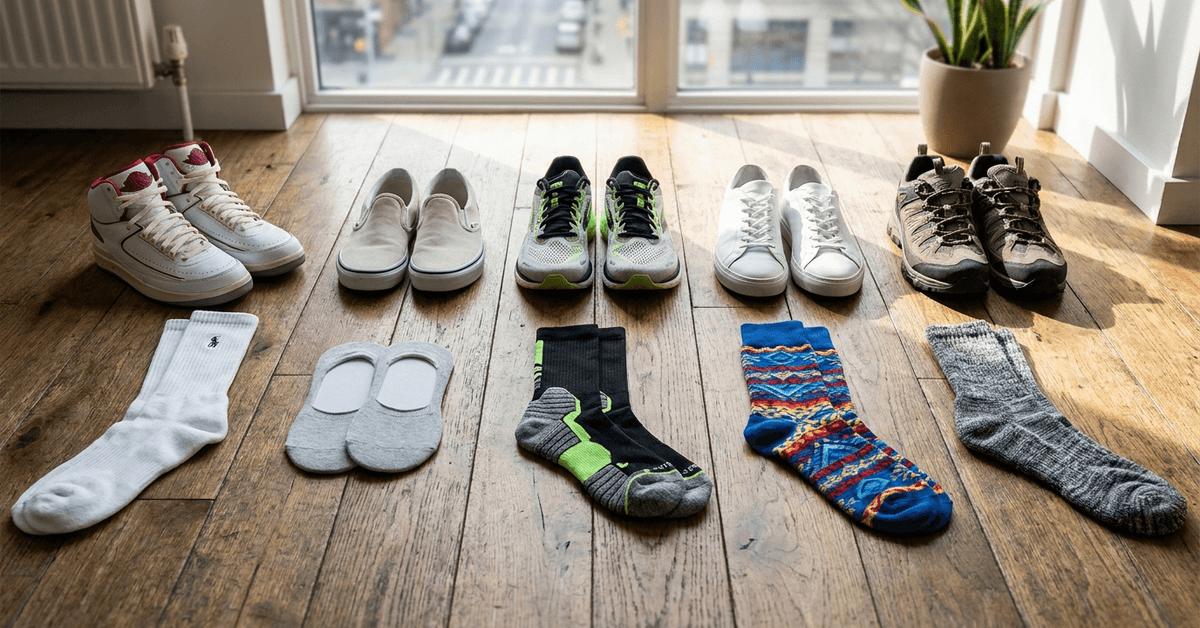
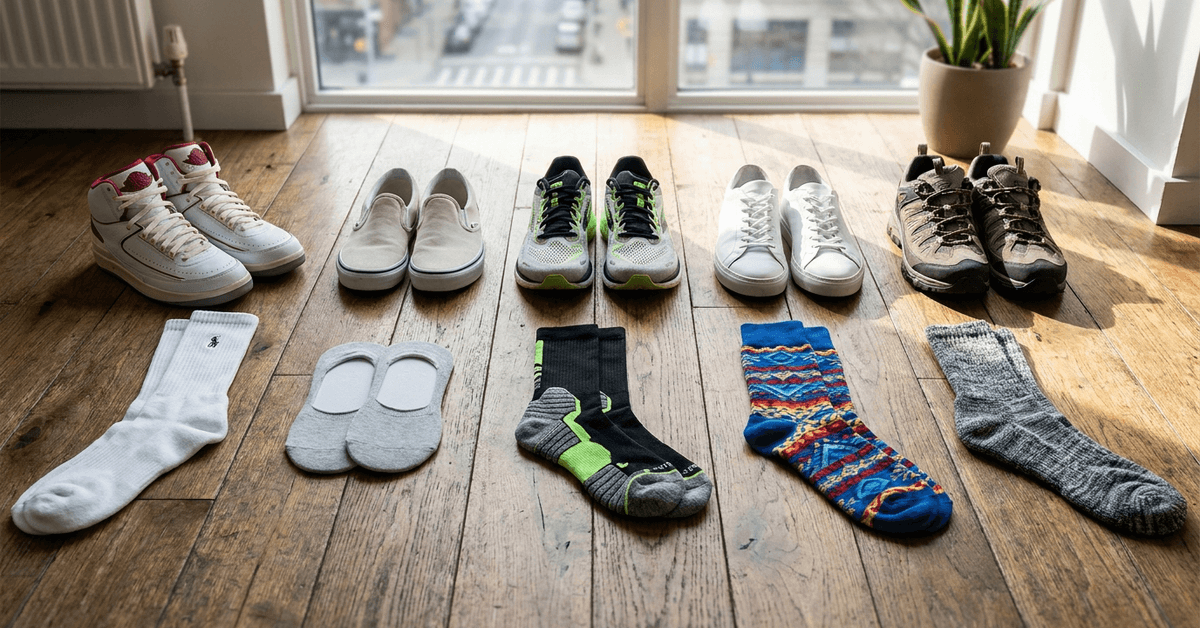
A thick sock can shift a sneaker’s fit by roughly half a size. That single choice wrecks more daily comfort than most sneaker buyers ever think to check.
Sock guides love ranking options by season or occasion. Almost none of them mention that sock thickness and fiber choice directly change how a sneaker sits on your foot.
This piece is for the urban daily walker: someone logging serious steps in sneakers between commutes, errands, and weekend outings across cities that test your feet constantly.
I think the sock game gets talked about like it’s purely a style decision, but when Merino wool and performance compression bands are on the table, the real split is functional.
How Sock Thickness Changes Your Sneaker Sizing
Most sneaker sizing advice assumes a standard-weight sock. Nobody specifies what “standard” means.
A thin no-show sock and a padded crew sock create completely different pressure profiles inside the same shoe, and that gap becomes obvious after a few thousand steps on concrete.
The issue is simple: a thicker sock compresses the toe box, raises the heel position slightly, and shifts where friction builds.
Sneaker enthusiasts who own multiple silhouettes already know that a Jordan 1 and a New Balance 990 respond to sock thickness in totally different ways. But they rarely connect sock choice to sizing when shopping for shoes.
Cotton Blends, Synthetics, and What the Fiber Split Means
Cotton-blend socks are the standard for casual sneaker wear. They breathe reasonably well, feel familiar, and wash without drama.
The downside: cotton holds moisture. A 100% cotton sock on a long summer walk turns into a damp sponge against your skin, and blisters follow.
Synthetic blends with moisture-wicking fibers dry faster and manage sweat better during movement. Performance socks lean heavily into polyester and nylon for this reason. The tradeoff is that pure synthetics can feel slippery inside certain sneaker linings.
My take on fiber choice comes down to one thing: a 60/40 cotton-synthetic blend handles both casual and active use without forcing a sock change midday. That ratio shows up in most mid-tier crew socks and holds up across temperature swings.
Crew Socks and No-Show Socks: Two Defaults That Don’t Deserve Equal Praise
These two types dominate sneaker sock conversations. Every roundup lists them first. And while crew socks earn their spot, I’d argue no-show socks are the most overhyped recommendation in sneaker culture right now.
Crew Socks for Daily Sneaker Wear
Crew socks cover the ankle and lower calf. They offset friction along the heel during long walks, and they pair with nearly any sneaker silhouette without looking out of place.
Good crew socks include built-in arch support, and that matters for anyone spending a full day on their feet across uneven city sidewalks. London fog in the morning, Amsterdam cool in the evening: crew socks handle variable conditions without a second thought.
A few details that separate a solid crew sock from a forgettable one:
- Reinforced heel and toe panels reduce wear in the two spots that break down fastest
- Ribbed cuffs that stay put without cutting circulation at the calf
- Flat-knit toe seams that eliminate the ridge most cheap socks leave across your toes
Crew socks are not exciting. They are correct. And for daily wear, correct beats clever every time.
The Silicone Tab Problem on No-Show Socks
No-show socks are supposed to disappear below the sneaker line. That’s the pitch: invisible comfort, clean look, nothing to distract from the shoe.
The problem? Those silicone grip tabs on the heel lose adhesion after two or three washes. Once the tab slips, the sock bunches under your arch or slides forward into the toe box. Now you’re adjusting your sock every few blocks, and the friction that no-show socks were designed to prevent is worse than if you’d worn a proper ankle sock.
I think no-show socks are the wrong default for daily sneaker wear, and I’d point to the silicone tab degradation as the specific reason. A thin ankle sock sits a few millimeters above the sneaker collar, stays in place all day, and creates zero bunching. The “invisible” look of a no-show sock lasts about a month of regular use before you’re fighting your own footwear.
For a summer outfit where the sock cannot be visible at all? Fine, wear a no-show. But the advice to buy a drawer full of them as your go-to sneaker sock is bad advice that creates more blisters than it prevents.
Performance, Statement and Merino Wool Socks
The other three sock types serve more specific roles. Each one fits a particular kind of day or activity, and mixing them into your rotation based on what you’re doing makes a bigger difference than defaulting to the same pair every morning.
Athletic Performance Socks for Urban Runners and Cyclists
Performance socks have moved out of the gym and into daily city use. Targeted cushioning in the ball and heel, mesh ventilation zones across the top of the foot, and compression bands around the arch are the standard feature set in 2026.
The compression bands are worth paying attention to. They hold the sock tight against the foot during repetitive motion, and they distribute pressure more evenly than a standard elastic cuff. City runners and weekend cyclists get the most from these socks, especially paired with athletic sneaker models built for movement.
A few things to check before buying performance socks:
- Cushioning density in the heel should feel firm, not squishy. Soft cushioning flattens within weeks.
- Mesh ventilation panels should sit on the top of the foot, not the sole. Sole ventilation wears through fast on pavement.
- Flat seam construction at the toe prevents hot spots during runs longer than 5K.
Apps like Strava track activity across city routes and can help match sock choice to the kind of movement you’re logging each week.
Graphic Socks as Outfit Anchors
Statement socks with colors, prints, or logos are popular in cities like Tokyo, Los Angeles, and Seoul. These socks become the outfit’s focal point when paired with monochrome sneakers.
The practical side: cotton with a small percentage of elastane holds prints sharp and keeps the sock fitted without sagging. Look for socks where the graphic is knitted into the fabric rather than printed on top. Screen-printed designs crack and peel after a handful of washes, while knitted patterns hold.
Local designers in large cities produce limited-run graphic socks, often sold at weekend markets and art fairs. These small-batch socks tend to use heavier cotton and better construction than mass-market graphic options.
| Sock Type | Best Use | Climate Fit | Pairs Best With |
|---|---|---|---|
| Crew | Daily commuting, all-purpose | Mild to cool | Any sneaker silhouette |
| No-Show | Summer outfit, low-top sneakers | Warm | Slip-ons, minimalist sneakers |
| Performance | Running, cycling, heavy walking | Any | Athletic sneakers, runners |
| Graphic/Statement | Style-forward outfits, events | Mild | Monochrome sneakers |
| Merino Wool | Long commutes, travel, variable weather | All seasons | Mid-tops, boots, chunky sneakers |
The takeaway: crew and merino wool cover the widest range of use, while the other three fill specific gaps.
Merino Wool Socks for Year-Round City Use
Merino wool has moved far from its hiking-only reputation. These socks regulate temperature across seasons, keeping feet cool when it’s warm and warm when it’s cold. That dual function makes them a strong pick for cities like Toronto or Zurich where mornings and afternoons can feel like different seasons.
The odor resistance of merino is a real advantage for anyone taking public transit. Synthetic socks trap bacteria and smell after a single heavy-use day. Merino’s natural antimicrobial properties push that timeline out significantly.
Merino socks are also lighter than most people expect. Modern merino blends at 17.5-micron fiber thickness feel closer to a dress sock than a hiking boot liner.
That thinness means they work inside slim sneaker profiles without creating pressure. Woolmark certifies fiber quality across brands, so checking for that label is a quick way to verify what you’re buying.
The one catch: merino costs more. A single pair runs two to three times the price of a cotton crew sock. But the lifespan tends to be longer, and the reduced need for daily washing (thanks to odor resistance) stretches each pair further.
Matching Socks to Activity and Climate
A day of museum-hopping calls for crew socks or statement socks. A morning run through a park before work needs performance socks.
A cross-city commute on a day where the temperature swings 10 degrees between morning and evening? Merino wool handles that shift better than cotton.
Care extends the life of every pair:
- Rotate socks daily and avoid wearing the same pair two days straight, especially on high-step days
- Hand-wash merino wool to prevent fiber breakdown in machine cycles
- Pack backup pairs when traveling between cities or staying out for long stretches
Hot-weather cities like Miami or Barcelona pull toward no-show and thin cotton options. Variable-weather cities like San Francisco or London reward wool and performance socks that adapt.
The best approach is owning all five types and picking based on the day’s plan rather than reaching for the same pair out of habit.
Questions People Ask About Socks for Sneakers
These are the questions that come up most when sneaker fans start paying attention to what goes on their feet before the shoe does.
- Q: Do no-show socks work with all sneaker types?
No-show socks work best with low-profile sneakers and slip-ons. Mid-tops and high-tops have enough collar height that an ankle sock stays hidden anyway, making no-show socks unnecessary in those cases. Stick with ankle or crew for anything above the ankle bone. - Q: Can merino wool socks be worn in summer?
Merino regulates temperature in both directions, so wearing them in warm weather is entirely practical. A lightweight 17.5-micron merino sock breathes better than a thick cotton sock and manages moisture more effectively. The main barrier is the higher price per pair. - Q: How often should sneaker socks be replaced?
Cotton crew socks lose elasticity and cushioning after about 6 months of regular rotation. Performance socks with compression bands degrade faster because the elastic fibers break down with repeated stretching. A good rule: if the arch band no longer grips snugly, swap them out. - Q: Are expensive socks worth it over budget options?
A $15 pair of merino socks that lasts 18 months and resists odor costs less per wear than a $3 cotton sock replaced every 4 months. The math favors quality in socks more than in most other clothing categories. Check seam construction and fiber content on the label before paying a premium for branding alone. - Q: Should sock color match the sneaker or the outfit?
Matching to the sneaker creates a clean, seamless line. Matching to the outfit pulls the look together as a whole. Contrasting both is where statement socks live. There is no rule, only intention: pick a direction and commit rather than landing somewhere accidentally neutral.
Conclusion
Sock choice shapes how a sneaker fits, feels, and performs across a full day of urban wear. The overlooked detail is thickness: get that wrong, and a perfectly sized shoe becomes a problem by afternoon.
Crew socks and merino wool cover more ground than any other two types in your drawer combined. Start there, build outward, and let the day’s plan pick the pair.