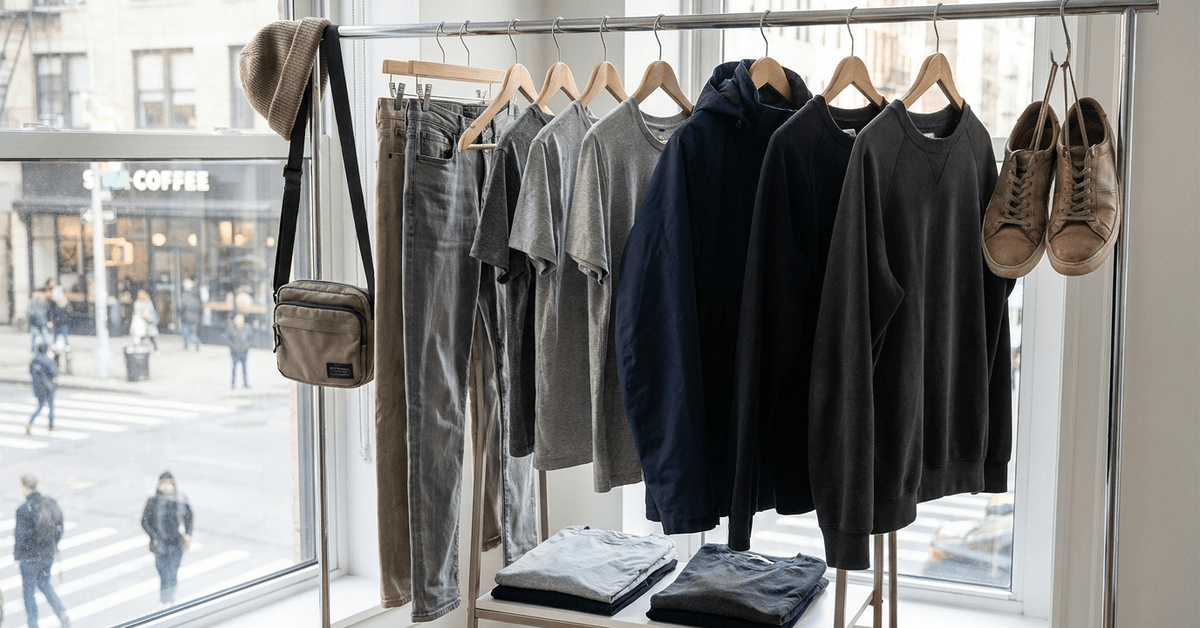
Fifteen minutes. That’s the gap between waking up and catching the 7:42 train, and it’s the exact moment a bloated closet punishes its owner hardest.
Capsule wardrobe guides love to promise simplicity. But most of them are designed around photo shoots, not the reality of someone who commutes on a packed subway, walks twelve blocks in unpredictable weather, and needs to look presentable at dinner the same night.
This article is written for one specific person: the urban apartment dweller who rides public transit daily and refuses to own a separate outfit for every micro-occasion the city throws at them.
I’d bet most capsule advice falls apart at that transit-to-office-to-evening test. The fix requires thinking about clothing as a system, not a list.
Why Capsule Wardrobe Guides Keep Failing City Commuters
The typical capsule wardrobe article hands readers a neat checklist: ten tops, five bottoms, three jackets, done.
But a checklist treats clothing like inventory. A working city wardrobe needs to handle temperature swings inside a single commute, sudden rain, and the social jump between a morning meeting and an evening bar.
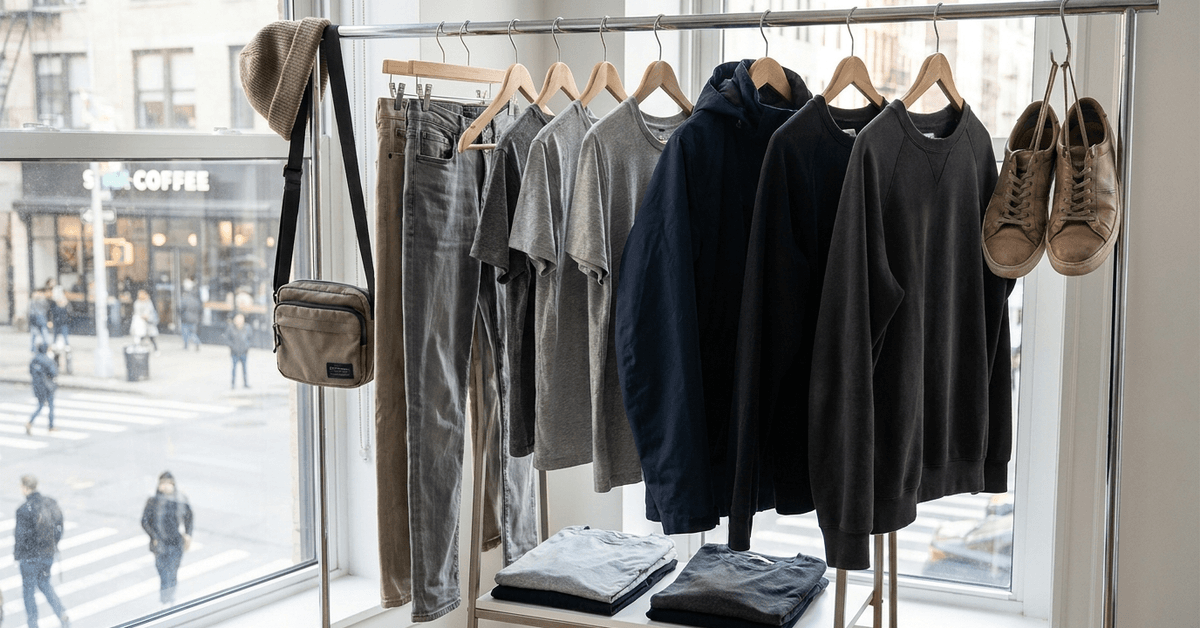
Think about a Tuesday in London or Berlin. The morning is 12°C and overcast. The subway car hits 28°C.
The office AC runs cold. A rooftop dinner drops back to 14°C after sunset. A capsule wardrobe that can’t flex through all four of those temperatures in one outfit rotation is a capsule wardrobe that fails on day one.
The Morning Rush Test
The real test of any wardrobe system happens during the morning scramble. Can every top pair with every bottom? Can every jacket layer over every shirt? If any combination requires a mental debate, the system has a hole.
A capsule street wardrobe earns its name when any random grab produces a workable outfit. That means restricting the total number of pieces forces each piece to carry more combinative weight.
A wardrobe of 25 items where every piece pairs with every other piece produces more outfits than 60 items that only work in fixed combinations.
Stop Building Around Neutrals First
I would challenge anyone to wear an all-neutral capsule for three weeks straight without feeling like they’ve flatlined.
I tested this idea against Cladwell’s outfit rotation data, and the app’s own algorithm starts repeating combinations faster when a wardrobe has no color contrast. My take: starting with a color anchor piece instead of a neutral foundation creates a wardrobe that feels different every day, even when the total piece count stays low.
The standard advice says: build your base in black, white, grey, and navy, then add one or two “pops of color.”
Sounds logical. But that sequence produces wardrobe fatigue faster than any other approach, because every outfit looks like a variation of the same outfit.
What a Color Anchor Does for a Small Wardrobe
Flip the process. Start with one statement jacket: a bomber in olive, a denim jacket in a washed tone, or a trench in camel. Build the rest of the wardrobe around pieces that work both with and without that jacket.
This method forces every subsequent purchase to earn its spot against a specific anchor. Neutrals still enter the wardrobe, but they enter as support pieces, not as the identity.
The result is a 20-piece rotation that looks like 40 because the color anchor creates visual separation between outfits that would otherwise blur together.
Core Pieces That Survive a Full Urban Day
No single list works for every city. Stockholm in January and Barcelona in July demand different fabrics entirely. But certain categories appear across every functional urban capsule, and the differences between cities show up in material weight, not in garment type.
The pieces below assume a temperate city with a transit commute. Adjust fabric weight for your specific climate, but the categories hold.
The Layer That Earns Its Spot
Layering pieces do the heaviest work in a city capsule. A packable rain jacket that fits inside a crossbody bag turns a sunny morning commute into a rainy evening walk without requiring a wardrobe change.
Thin knit sweaters that sit flat under a jacket add warmth on cold subway platforms without adding bulk in a heated office.
I’d rank a lightweight, weatherproof outer layer as the single most important piece for anyone commuting through cities like London, Berlin, or Toronto. A quality rain jacket at around $80 to $150 gets more daily use than a $300 blazer that only works for office settings.
Shoes That Cross Contexts
Shoes are where most capsule wardrobes quietly break. A single pair rarely handles a full day that spans cobblestones, office carpet, and a restaurant floor. Two pairs as a minimum, three if the climate demands waterproofing.
| Shoe Type | Best Context | Limitation |
|---|---|---|
| Walking sneakers | Commute, errands, casual dining | Too informal for client meetings |
| Sleek loafers or Chelsea boots | Office, dinners, evening events | Less comfortable for long walks |
| Waterproof boots or sneakers | Rain, shoulder season, winter | Heavier, can look bulky with slim fits |
The takeaway: owning three pairs that cover these contexts beats owning six pairs that overlap.
Micro-Capsules for Specific City Scenarios
The smartest approach I’ve seen among city dwellers treats the capsule as a set of smaller kits that overlap. Instead of one monolithic wardrobe, build micro-capsules for recurring situations.
This concept works because city life runs on repeating scenarios, not on infinite variety. A rainy commute kit, an office-to-evening swap, and a weekend errand outfit cover roughly 90% of real urban days.
Rainy Day Kit
A single rainy-day micro-capsule eliminates the frantic morning scramble when the forecast turns:
- Packable rain jacket or water-resistant trench, rolled inside a tote or crossbody bag
- Dark jeans or chinos that hide water spots and dry quickly on transit
- Waterproof sneakers or boots kept near the door, ready to swap in without a second thought
Office-to-Evening Swap
The office-to-dinner problem kills more capsule wardrobes than any other scenario. One small fix solves it:
- Swap the outer layer only: trade a blazer or structured jacket for a bomber or leather jacket stashed at the office
- Switch shoes: loafers to sneakers (or the reverse) changes the entire outfit read
- Add one accessory: a scarf, a different watch strap, or a crossbody bag shifts the formality level without a full outfit change
This approach means carrying one extra item, not an entire second outfit.
Apps and Tools for Capsule Wardrobe Planning
Digital tools take the guesswork out of building a capsule, especially for people who struggle to visualize outfit combinations.
Cladwell suggests daily outfits based on local weather and the user’s existing wardrobe. The app tracks what gets worn and what sits untouched, which makes seasonal edits easier.
Stylebook runs a similar inventory system and calculates cost-per-wear, a metric that exposes which pieces earn their price and which were impulse buys.
Pairing either app with a reliable weather app turns the morning decision into a 30-second check. The outfit suggestion handles the style side. The weather forecast handles the layering side.
Seasonal Swaps Without Rebuilding the Whole Wardrobe
A well-built capsule only needs small adjustments between seasons, not a complete overhaul.
The core pieces (jeans, tees, layering shirts, one statement jacket) carry through year-round. Seasonal swaps target the extremes: thermal undershirts and wool layers for winter, linen shirts and lighter knits for summer.
Shopping for Capsule Pieces That Last
Speed and price drive most urban clothing purchases, but a capsule wardrobe rewards patience. Local vintage shops in neighborhoods like Kreuzberg in Berlin or Shibuya in Tokyo carry one-of-a-kind finds that no fast fashion chain can replicate.
Platforms like Vinted give older pieces a second life and cut the cost of building a capsule. Seasonal reviews (once in spring, once in fall) keep the wardrobe tight. Swap worn basics, rotate statement pieces, and donate or resell anything that hasn’t been worn in 60 days.
A few principles for buying well:
- Check fabric composition on the tag: cotton blends and wool hold shape longer than pure synthetics
- Try the transit test: sit, stand, reach overhead, and bend before buying anything meant for commuting
- Skip trend-driven pieces unless they double as a daily wear item for at least two seasons
Questions People Ask About Capsule Street Wardrobes
These are the questions that come up most often when building a functional city wardrobe.
- Q: How many pieces should a capsule street wardrobe have? A good range sits between 20 and 30 total items, including shoes and outerwear. The exact count depends on how many distinct contexts fill a typical week. Someone who works from home three days needs fewer office pieces than a daily commuter.
- Q: Do capsule wardrobes get boring after a few weeks? Wardrobe fatigue usually comes from a lack of visual contrast between outfits, not from owning too few items. Adding one color anchor piece and rotating accessories (scarves, hats, bags) breaks the monotony without adding bulk.
- Q: Should I follow my city’s street style trends when building a capsule? Neighborhood style offers useful cues for silhouette and proportion, but trend-chasing defeats the point of a capsule. Borrow the fit sensibility of a city like Copenhagen or Tokyo, then build around pieces that outlast any single season’s look.
Conclusion
A capsule street wardrobe works best when each piece passes the transit-to-dinner test every single day. The smallest wardrobes often produce the most confident mornings, because the decision is already made.
Seasonal swaps and a single color anchor keep the rotation fresh without adding clutter to a small apartment. Start with the jacket, build around it, and let the city do the styling.