A leather wallet gets pulled from a pocket 30 or more times a day in cities like Tokyo and New York. That kind of handling warps stitching within months.
Leather care advice tends to assume a calm indoor life. Condition it, store it flat. None of that accounts for a belt bending against a subway seat for 45 minutes each morning.
Commuters dealing with pollution buildup in Mumbai, sudden rainstorms in London, and dry AC offices in Dubai face a specific set of leather problems that generic guides ignore entirely.
This piece is for the urban professional whose premium leather belt or wallet takes a beating five days a week and needs a care routine designed for that reality.
What City Air and Weather Cycling Do to Leather
Leather reacts to its environment far more than most people assume. And city environments are especially hostile, not because of any single factor, but because of how many stressors hit at once during a regular commute.
A belt worn through a morning in Madrid might face scorching sun on a café terrace, then cold air conditioning in an office, then rain on the walk to the metro. Each shift forces the leather to expand and contract.
Over weeks, those micro-movements produce surface cracks that seem to appear out of nowhere.
Pollution Buildup on Belts and Wallets
Cities like Paris, Mexico City, and Mumbai push airborne soot and particulate matter onto every exposed surface. Leather absorbs those particles into its grain. The result is a slow, uneven color fade that most people mistake for natural aging.
This kind of damage doesn’t wash off with a quick wipe. The particles embed themselves, and without regular surface cleaning, they chemically interact with dyes over time.
A wallet carried daily through a polluted metro corridor will look noticeably duller than one stored at home within about six months.
The AC-to-Street Temperature Trap
I think the least-discussed leather killer is the rapid temperature cycling between air-conditioned interiors and humid outdoor air, particularly in cities like Singapore and Miami.
Leather care guides almost never address this, but the constant shift between dry cool air and tropical moisture puts leather through a stress cycle that sustained exposure to either condition alone wouldn’t cause.
That cycling pulls moisture in and pushes it out repeatedly. The leather fibers lose elasticity.
And once elasticity goes, cracking and stiffness follow fast. A wallet living in a consistent environment, even a humid one, holds up better than one that swings between 18°C AC and 35°C street air six times a day.
Daily Leather Habits That Take 30 Seconds
The good news is that most damage from urban conditions can be slowed down with habits that cost nothing and take almost no time. These aren’t spa-day treatments. They’re small defensive moves that compound over months.
The Post-Commute Wipe
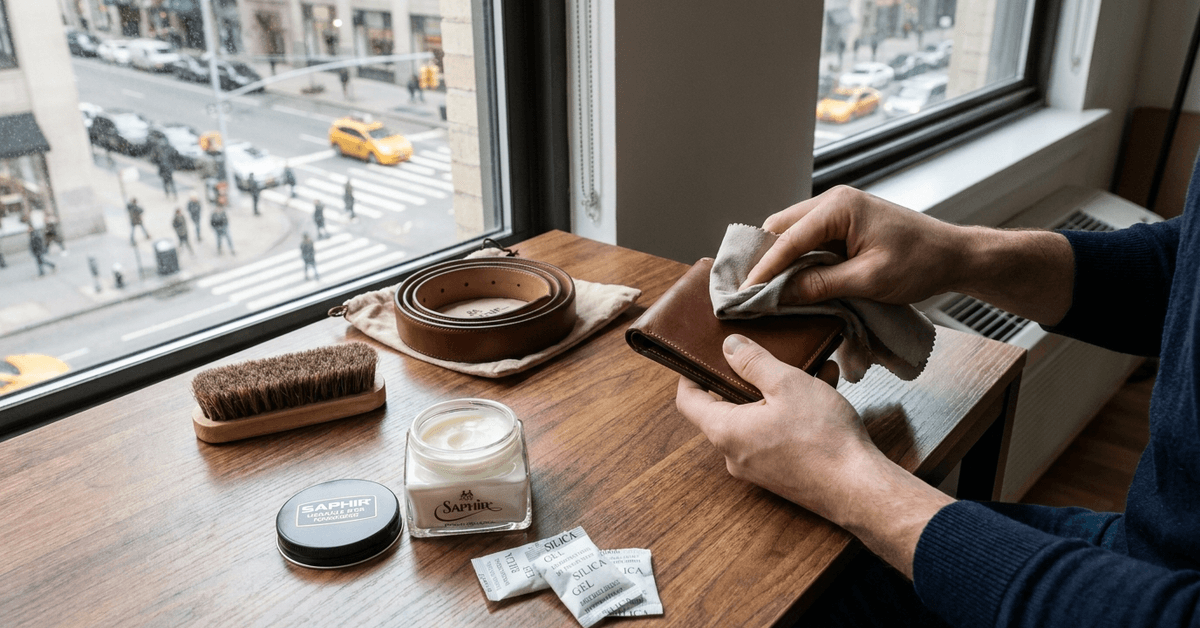
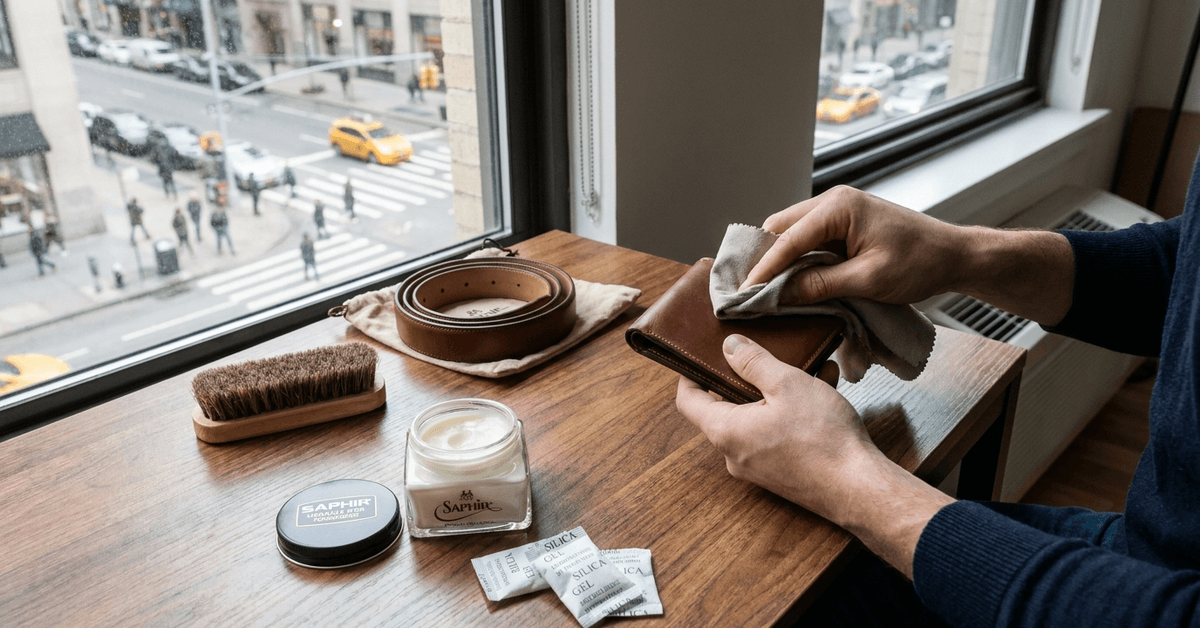
A soft microfiber cloth dragged lightly across a belt or wallet after arriving home removes soot and surface moisture before they have time to settle into the grain. This single habit does more than any monthly deep clean.
Getting caught in rain? Pat the leather dry immediately. Never rub a water spot or a salt stain, because friction pushes the moisture deeper and sets the mark instead of lifting it.
Rotation Beats Constant Conditioning
Switching between two wallets or two belts every few days gives leather recovery time. The fibers relax, moisture levels rebalance, and wear distributes across multiple pieces instead of concentrating on one.
I would take rotation over frequent conditioning for anyone commuting daily in cities like Milan, Seoul, or London. Two mid-range leather wallets rotated weekly will outlast a single expensive wallet conditioned monthly, because the rest period matters more than the product applied.
And on the topic of conditioning frequency: I think the standard advice to condition leather monthly is doing more harm than good for people who work in climate-controlled offices.
A wallet sitting in a 22°C, 40%-humidity office for 8 or 9 hours a day is not drying out the way leather on a ranch fence post does. Quarterly conditioning with something like the Saphir Medaille d’Or Pommadier protects without over-saturating.
Monthly application on office leather leads to soft, floppy material that loses its shape and starts holding creases permanently.
Stop Overstuffing the Wallet
This one sounds obvious until you see how many people ignore it. Cramming 15 cards and a stack of receipts into a bifold stretches seams and warps corners. The leather can’t recover from sustained pressure like that.
Keep daily carry to the cards and cash that get used regularly. Everything else belongs in a separate card holder or stays home.
Products, Deep Cleaning, and a Side-by-Side Comparison
Once daily habits are locked in, occasional deep care fills the gaps. The right products make a difference here, and the wrong ones can strip natural oils faster than city pollution does.
Picking the Right Cleaner for City Grime
pH-neutral soap mixed with distilled water is the safest starting point for any leather type. A few drops on a soft cloth, gentle circular motions, and a slow air dry away from heat. That handles surface buildup from a month of city commuting.
For deeper nourishment, cream-based conditioners outperform spray-on products because they absorb more evenly. The Saphir Pommadier mentioned earlier is a solid pick, but any cream with a neutral pH and no petroleum base will do similar work.
One product to avoid entirely: standard hand soap. It strips the natural oils that keep leather supple, and the result is dry, cracked material within weeks. This is the most common mistake among city residents who grab whatever is next to the sink.
A horsehair brush works well as a finishing tool after conditioning. Light buffing restores surface sheen without adding more product.
| Feature | pH-Neutral Soap + Distilled Water | Saphir Medaille d’Or Pommadier |
|---|---|---|
| Best for | Regular surface cleaning | Deep nourishment and color restoration |
| Frequency | Every 2 to 4 weeks | Quarterly for office-bound leather |
| Leather types | All smooth leathers | Smooth and lightly grained |
| Risk of damage | Very low | Low, but over-application softens structure |
| Price range | Under $5 per cleaning session | Around $20 to $30 per jar |
The takeaway: pH-neutral soap handles routine maintenance, while cream conditioner does the heavier lifting on a less frequent schedule.
Storing Leather in Small Apartments
Compact city apartments force creative storage. But leather belts and wallets crammed into overcrowded drawers or left on radiators degrade quickly.
A few storage adjustments that work in tight spaces:
- A shallow, velvet-lined drawer keeps belts flat and wallets separated from keys and coins that cause scuffs
- Original dust bags from brands like Montblanc or Coach add a barrier against dust and humidity
- Silica gel packets tucked into storage compartments absorb excess moisture, a cheap trick that residents in Hong Kong and other high-humidity cities rely on
- A spot away from radiators and direct sunlight prevents the dried, warped leather that comes from sustained heat exposure
Quick Fixes for Water Stains, Scratches, and Stubborn Marks
Damage happens no matter how careful the routine. The difference is how fast the response comes.
Water stains respond best to immediate dabbing with a dry, soft cloth. A small amount of conditioner blended into the edges of the stain can minimize visible rings, though results depend on the leather type and stain severity.
Scratches and scuffs sometimes fix themselves. Rubbing a clean finger along a light scratch redistributes surface oils and softens the mark. Deeper scratches need a matching polish applied in thin layers.
Stubborn stains that resist home treatment call for professional restoration. City-based leather repair services, easy to find through platforms like Yelp, handle chemical stains and deep discoloration that DIY methods can’t touch. Results vary depending on stain type and leather grade, so setting expectations matters.
Common mistakes that accelerate damage instead of fixing it:
- Leaving wallets in back pockets during long metro rides, which causes deep creasing over weeks
- Hanging belts on hooks near radiators or heating vents, where sustained dry heat warps the leather
- Reaching for household cleaning products like dish soap or all-purpose spray, both of which strip protective oils
Questions People Ask About Leather Belt and Wallet Care
These come up often enough that they deserve direct answers.
- Q: How often should I clean a leather wallet I carry every day in a city?
A light wipe with a microfiber cloth after each commute handles 90% of daily grime. A deeper clean with pH-neutral soap every two to four weeks keeps the grain clear. That schedule covers the demands of regular urban use without overdoing it. - Q: Can humidity permanently ruin a leather belt?
Sustained humidity without airflow can cause mold, especially on vegetable-tanned leather stored in enclosed spaces. Silica gel packets and periodic airing prevent this. Catching mold early means a gentle wipe with diluted white vinegar usually removes it. - Q: Does sunlight damage leather faster than rain?
Direct UV causes irreversible color fading, while rain stains can often be treated or reduced. Cities with strong sunlight like Sydney and Cape Town see more premature leather aging from UV than from moisture alone. Keeping leather out of sustained direct sunlight matters more than dodging every rainstorm. - Q: Are leather care apps worth downloading?
Apps like Trove can track purchase dates and send conditioning reminders, which helps for people managing several leather pieces. The practical value depends on how many items someone rotates. For a single wallet and belt, a calendar reminder works just as well. - Q: Is expensive leather conditioner better than cheap alternatives?
Price matters less than formulation. A $25 jar of Saphir cream and a $5 bottle of pH-neutral soap both protect leather well when applied correctly. The expensive product absorbs more evenly and restores color better, but the cheap option handles basic maintenance perfectly.
Conclusion
City leather needs a care approach built for the specific abuse it faces every day. Generic advice written for quiet suburban closets falls short for daily commuters.
Quarterly conditioning works better than monthly for office-bound leather that rarely dries out naturally. Rotation, daily wiping, and smart storage outperform expensive products applied too often and too generously.
The premium leather belt or wallet that looks best after two years is the one whose owner matched their routine to their city’s conditions.