A cracked sunglasses lens and a phone charger knotted around your earbuds. That is how most duffel bags greet their owners after a two-hour train ride.
Suitcases have rigid walls and fixed compartments that hold items in place. A duffel bag has zero internal structure, so every loose item rolls into every other item the second it moves.
This piece is for the weekend city-tripper who grabs a duffel for speed and flexibility, then pays for that choice somewhere between the taxi and the hotel lobby.
The fix is less about buying fancy organizers and more about understanding how soft bags behave when they are carried, tossed, and squeezed into overhead bins.
Why Every Duffel Bag Turns Into a Junk Drawer
A suitcase punishes bad packing by refusing to close. A duffel punishes bad packing silently. It zips shut just fine, and then the damage happens during transit. Cables wrap around watch bands.
Charger bricks press into screens. Leaked moisturizer coats a transit card. The softness that makes a duffel easy to carry is the same thing that makes it destructive to accessories.
Soft Walls Mean Everything Shifts
Rigid luggage keeps a power bank on the left side where it was placed. A duffel bag made of canvas or nylon allows that power bank to migrate across the entire bag during a subway ride or a short walk across an airport terminal.
Cities like New York and Tokyo demand quick movement between trains, rideshares, and terminals. Every sharp turn or overhead-bin shove sends unsecured items tumbling into each other.
The problem compounds when a traveler packs flat items (transit cards, notebooks) next to bulky items (charger bricks, toiletry bottles). The flat items fold or crease.
The bulky items crush anything soft pressed against them. There is no internal wall to prevent this. And that one fact changes how every item should be placed.
Picking a Duffel Bag Material That Handles Rain and Rough Handling
The bag itself does half the work if the material is right. A cheap polyester duffel absorbs water in a London drizzle and transfers it straight to electronics.
The two materials worth considering for city trips are water-resistant canvas and ripstop nylon, both of which repel light rain and resist tearing when squeezed into lockers or shoved under airplane seats.
Ripstop Nylon for Travelers Who Move Fast
Ripstop nylon is lighter, dries faster, and can compress into tighter spaces. For a weekend city trip where the bag goes from airport to train to hotel room in a few hours, this material keeps the total carry weight lower while protecting gear from unexpected weather changes.
Built-In Compartments Save More Time Than Packing Cubes
Brands like Aer and Patagonia build duffels with zipped tech sleeves and small mesh pockets sewn into the interior walls. These built-in dividers prevent sunglasses from grinding against watch faces during transit.
I think the Aer Travel Duffel gets this detail right better than most competitors because its tech sleeve sits along the bag’s side panel instead of the bottom, keeping electronics away from the heaviest items.
A bag without any internal pockets forces the traveler to buy separate organizer pouches for every category. A bag with three to four built-in sections cuts that need in half.
A Layering System That Gives a Duffel Its Missing Skeleton
Most packing guides treat a duffel like a suitcase with a zipper: lay things flat, stack in layers, done. That advice ignores the single biggest difference between the two bags.
A duffel has no rigid frame, so it collapses inward and shifts during movement. The packing order needs to create the frame that the bag itself does not have.
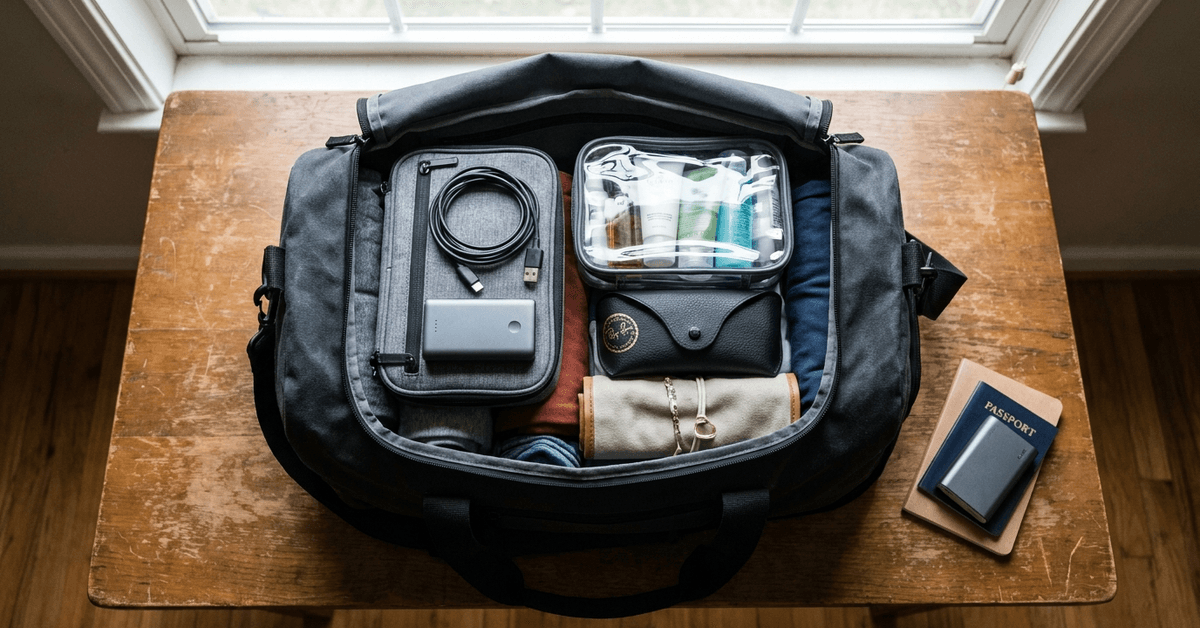
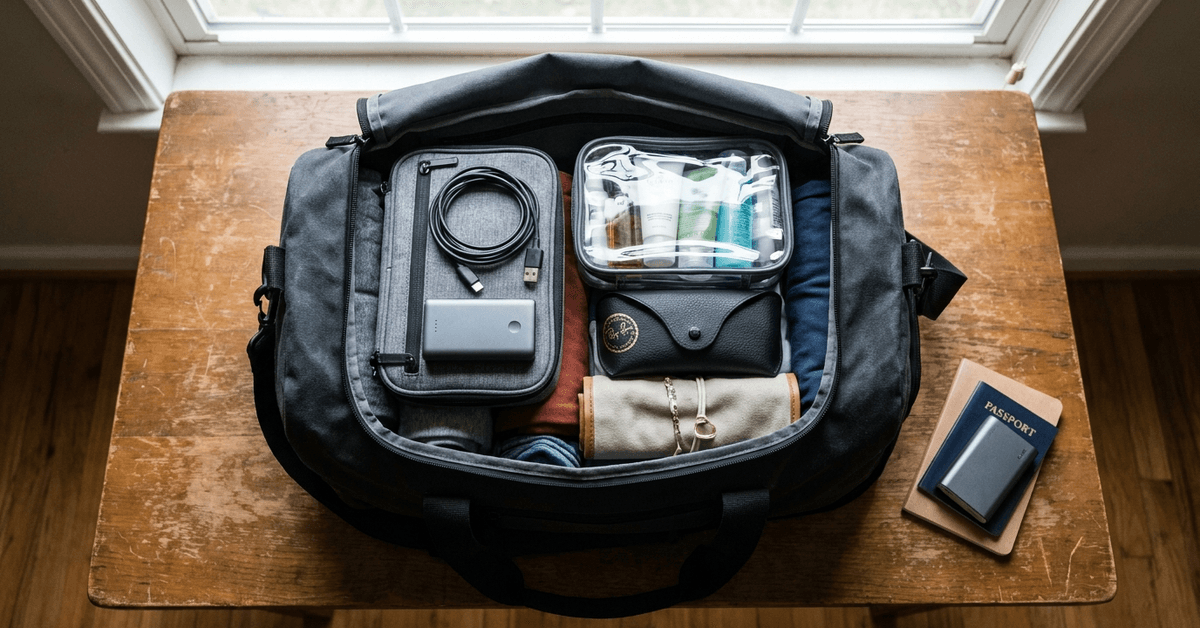
The rigid items go in first. Charger bricks, hard-shell sunglasses cases, toiletry kits with stiff walls: these become the internal skeleton. Place them along the bottom and the two short ends of the bag, and they hold the duffel’s shape from the inside out.
Everything packed after that stays more stable because it is resting against a self-made structure rather than a floppy nylon floor.
Heavy Items Go Near the Straps for Balanced Carry
Power banks and full-size chargers should sit at the bag’s bottom, close to the shoulder strap attachment points. This placement lowers the center of gravity and keeps the bag from tipping sideways during long walks through metro stations or across airport concourses.
Light items (earbuds, cables, transit cards) go toward the top and sides. Flat accessories like city maps, tablets, or thin notebooks should line the interior walls, pressed flat between the bag’s side panel and the soft items in the middle.
Leak-Proof Containers Are the Only Option for Liquids
Toiletries fail inside duffel bags more often than inside suitcases because the constant compression squeezes bottles. Leak-proof silicone bottles from brands like Muji and Humangear resist that pressure far better than standard flip-cap travel bottles. A clear zip pouch adds a second barrier and speeds up security screening at airports like Schiphol or Heathrow.
Liquids should sit in their own isolated zone, never touching electronics or paper items. The middle section of the bag, wrapped in the clothing layer, is the best spot.
Daily-Grab Items Belong in Exterior Pockets. Period.
I would never pack a transit card, wallet, or hand sanitizer “on top” inside a duffel’s main compartment. That advice shows up in almost every packing guide, and I think it fails specifically because of how duffel bags work. A duffel has no rigid top.
The moment the bag tilts, sags, or gets squeezed, whatever was “on top” slides into the middle and disappears.
Exterior zippered pockets exist for this reason. A passport, a transit card, a foldable water bottle, hand sanitizer: these go in an outer pocket where they can be grabbed without unzipping the main compartment.
Every time the main compartment opens, the carefully arranged layers inside get disturbed. Fewer openings means fewer chances for items to shift and tangle.
| Packing Zone | What Goes There | Why This Spot |
|---|---|---|
| Bottom (near straps) | Charger bricks, power banks, hard cases | Lowers center of gravity, creates base structure |
| Side walls | Tablets, notebooks, flat accessories | Pressed flat, adds rigidity to bag shape |
| Center (wrapped in clothes) | Silicone toiletry bottles in zip pouch | Cushioned, isolated from electronics |
| Top interior | Earbuds, cables in a small mesh bag | Accessible but still protected |
| Exterior pockets | Wallet, transit card, sanitizer, passport | Zero need to open main compartment |
The bottom row is the one most packing guides get wrong for duffel bags.
Fixing the Three Problems Every Duffel Packer Hits
Certain problems repeat trip after trip for duffel users. The solutions are cheaper and simpler than most travel gear sites suggest.
Tangled Cables and the Cheapest Fix
Reusable silicone cable ties cost almost nothing and solve the single most common duffel complaint. Loop each cable individually, secure it with a tie, and drop all tied cables into one small mesh pouch.
The Bellroy Tech Kit does this job well, but a basic zippered mesh bag from Muji works just as effectively for a fraction of the cost.
AirPod cables, phone chargers, and portable battery cords are the worst offenders. They wrap around anything they touch. Individual ties prevent that.
Crushed Accessories and the Sandwich Method
Fragile items need padding on both sides. Sunglasses go inside a hard case, then get placed between two rolled t-shirts.
A watch goes into a small rigid pouch, then between folded pants. This sandwich method absorbs the bumps of city travel: subway jolts, taxi stops, escalator jostles.
Items that benefit from the sandwich approach:
- Sunglasses or reading glasses in a hard case, placed between soft clothing layers
- Watches or jewelry in a small rigid pouch, positioned away from the bag’s bottom
- A tablet or e-reader wrapped in a microfiber cloth, pressed flat against the bag’s side wall
- Cosmetics in hard-shell toiletry kits, separated from any loose items by a clothing buffer
Pouch Labeling Saves Time at 6 AM
A small sticker label on each pouch (Moleskine makes durable ones that stick to nylon and mesh) removes the guesswork during early morning departures.
“Tech,” “Liquids,” “Daily” on three pouches means grabbing the right one without opening and checking each bag.
Bright or patterned pouches add a visual shortcut. A red pouch and a blue pouch are distinguishable inside a dark duffel interior where two identical black pouches are not.
Apps That Organize the Bag Before the Trip Starts
PackPoint generates categorized packing lists based on trip length, destination weather, and planned activities. Adding “city walking tour” and “business dinner” to the same trip produces a combined list that covers both contexts, reducing the odds of forgetting a portable charger or a nicer pair of shoes.
Citymapper and Moovit are transit apps, but they double as packing planners. Knowing that a Tokyo itinerary involves four train transfers and a 20-minute walk helps decide which items need to be in the exterior pocket versus buried in the main compartment.
RFID-blocking pouches may be worth considering for travelers who use contactless cards heavily throughout European or Asian transit systems. A small Tile Mate tracker attached to a wallet pouch adds a recovery option if a pouch gets left behind at a café or museum.
Questions People Ask About Packing a Travel Duffel Bag
These are the questions that come up most often when people try to organize a soft-sided bag for a city trip.
- Q: Can a duffel bag protect electronics as well as a backpack?
A duffel can match a backpack if the electronics sit inside a padded sleeve or hard-shell case and stay positioned along the bag’s side wall. The problem is never the bag type. It is always the lack of a rigid barrier between electronics and everything else. - Q: How do I stop toiletries from leaking inside a duffel bag?
Silicone bottles with twist-lock caps, like those from Humangear, resist the compression that causes standard bottles to leak. Double-bag them inside a clear zip pouch, and place that pouch in the center of the bag surrounded by clothing. - Q: Are packing cubes worth buying for a duffel bag?
Cubes help separate clothing categories, but for accessories, small zippered mesh pouches work better because they are thinner and fit into the narrow spaces along a duffel’s curved walls. Cubes are rigid rectangles designed for suitcase interiors. - Q: What is the best way to pack jewelry for a city trip?
A small rigid pouch or hard-shell case keeps rings and earrings from scratching. Place it between clothing layers in the bag’s center. Avoid exterior pockets for jewelry because those are the first target in crowded transit. - Q: Do I really need a water-resistant duffel for urban travel?
One surprise rainstorm in any city answers this question permanently. Ripstop nylon or treated canvas protects everything inside the bag for the few minutes it takes to get from a bus stop to a building entrance, and those few minutes matter when the bag holds a tablet and a phone charger.
Conclusion
A duffel bag packed with intent travels just as cleanly as a rigid suitcase, and it fits into spaces a suitcase never could. The layering trick of building a skeleton from rigid items first changes how the entire bag performs during transit.
Cheap mesh pouches, silicone cable ties, and labeled dividers solve problems that expensive organizer kits market themselves on. Pack the structure first, grab the exterior pocket second, and the duffel stops being a junk drawer.