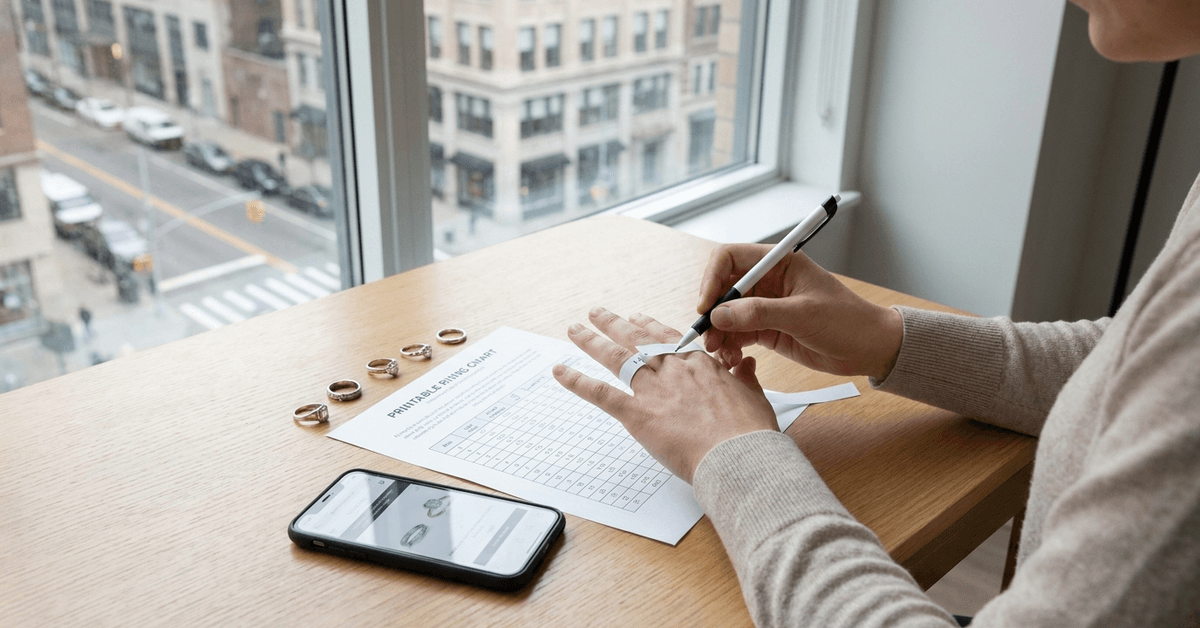
A strip of paper, a ruler, and a conversion chart. That is the most repeated ring sizing advice on the internet, and it has one of the highest error rates of any DIY measurement method.
Most online guides treat the paper strip trick like a reliable starting point. The problem is that paper stretches, finger pressure varies, and a millimeter of slack translates to a full size difference on a conversion chart.
This article is for the person ordering a ring online, especially someone shopping for a partner who can’t walk into a jeweler unnoticed. Secret engagement ring buyers, long-distance couples, and anyone allergic to jewelry store small talk: this one is built for you.
The Paper Strip Problem Every Guide Recommends
The paper strip method appears in almost every ring sizing article published in the last decade. Cut a strip, wrap it around the finger, mark it, measure it, and convert. Simple enough on paper. Terrible in practice.
I’d argue that the paper strip is the single least reliable home method, and I think Blue Nile’s own printable ring sizer gives better results because it removes the variable of hand-drawn marks on flimsy material.
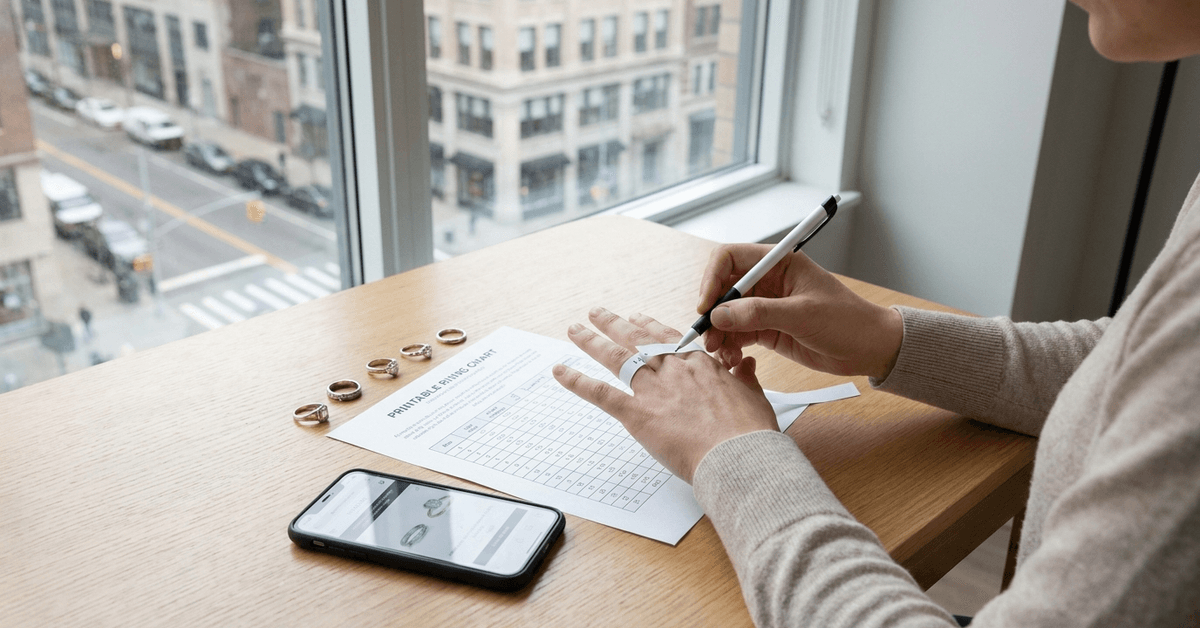
The strip stretches when you pull it snug. It loosens when you try to mark it. And the difference between a size 6 and a size 7 is roughly 2.5 millimeters: about the width of a pencil tip.
Where the Measurement Goes Wrong
Paper absorbs moisture from your skin, which causes micro-expansion during the few seconds it takes to wrap and mark. The mark itself introduces error because a ballpoint pen tip is about 0.5mm wide.
So the margin for error on a paper strip measurement is close to the margin between whole sizes.
A printable ring sizer from a reputable jeweler, cut carefully and placed flat, removes two of those variables.
The sizing circles are pre-measured and don’t stretch. That said, even printable tools depend on your printer scaling at exactly 100%, and most people never check that setting.
The Comparison Ring Trick That Skips the Strip Entirely
If the person already owns a ring that fits well on the correct finger, place it flat on a printed sizing chart. Match the inner edge to the closest circle. This method cuts out wrapping, marking, and measuring entirely.
A stolen ring from a jewelry box (borrowed temporarily, obviously) against a Blue Nile ring size chart gives a faster, more consistent result than any strip measurement. For secret shoppers, this is the move.
Ring Size Scales Are Different Across Every Country
A size 7 in the US means nothing in London. And a European 56 tells you nothing in Tokyo. The lack of a single global ring sizing standard is the second biggest trap for anyone ordering internationally.
US, UK, and European Ring Sizes Decoded
The US and Canada use a numeric scale starting around size 3 and going past 13.
The UK and Australia use alphabetic sizing (L, M, N), while Europe measures rings by inner circumference in millimeters. Japan uses its own numeric system that starts lower than the US scale.
| Region | System | Example Sizes |
|---|---|---|
| US / Canada | Numeric | 5, 6, 7, 8 |
| UK / Australia | Alphabetic | J, L, N, P |
| Europe | Millimeters (circumference) | 50, 52, 54, 56 |
| Japan | Numeric (different scale) | 7, 9, 11, 13 |
The takeaway: always confirm which sizing system a retailer uses before ordering, especially when buying from shops based outside your country.
Conversions for Expats and Travelers
Anyone living in Paris but ordering from a US-based jeweler (or vice versa) needs a conversion chart they trust. A European size 52 converts to roughly a US 6, but the “roughly” matters.
Half sizes exist in the US system and do not have direct European equivalents.
I would pick the larger size when stuck between two conversions, and Pandora’s international ring size guide is one of the cleaner references for checking multi-system equivalents.
Ordering a half size up means a slightly loose ring that can be resized down. Ordering tight means potential cutting-off-circulation territory.
Smarter Home Sizing Methods That Outperform Paper
The paper strip gets recommended because it requires zero tools. But a smartphone, a printer, or even an existing ring can produce better results with the same amount of effort.
Mobile Apps That Measure Ring Size
Ring Sizer by Jason Withers is a free app available on iOS and Android. Point the camera at a ring or use the on-screen guide to measure a finger directly. The app converts to multiple international systems automatically.
Does it replace a jeweler’s mandrel? No. Does it beat wrapping wet paper around your ring finger at midnight? Absolutely. The app works best in good lighting against a flat, contrasting surface.
Printable Ring Sizers Done Right
Several jewelry retailers offer PDF ring sizers, but the print settings matter more than the sizer itself. A few things to double-check:
- Print at exactly 100% scale (not “fit to page,” which shrinks the template)
- Verify accuracy by measuring the printed ruler against a physical ruler
- Cut along the outer edge, not through the line itself
- Test on the correct finger of the correct hand (ring fingers differ between left and right)
Double Up on Methods
No single home method is accurate enough on its own. The most reliable approach uses two different methods and compares the results. Measure once using a printable sizer, then verify against an existing ring or the app.
If both agree, that size is probably right. If they disagree by a full size, something went wrong and a third method is worth trying.
Finger Size Changes During the Day (and Season)
This part gets buried in most ring guides, but it matters more than the measurement tool. Fingers swell and shrink based on temperature, activity, and time of day.
Morning vs. Evening Sizing
Fingers tend to be smallest in the morning and largest in the evening. After a day of walking, commuting, or working with your hands, blood pools in the extremities.
A ring that fits snugly at 8 AM might spin freely. The same ring might feel tight at 9 PM after a summer walk.
The practical advice: measure twice in one day, once in the morning and once at night. The correct size sits between the two readings.
Heat, Humidity, and Altitude
Summer heat in cities like Barcelona or Rome causes temporary swelling. Cold weather shrinks fingers.
Anyone sizing a ring in July should know that December might require a different fit. Measuring in moderate indoor conditions, around 20°C to 22°C, gives the most consistent reading.
High altitude has a similar swelling effect. Someone living in Denver or Mexico City might measure a half size larger than the same person at sea level.
The Resizing Safety Net and Its Limits
Retailers like Pandora and Mejuri offer free or low-cost resizing within a set window after purchase. James Allen and Blue Nile have similar policies. Knowing the resizing policy before buying is as important as knowing the size.
But resizing has limits that most guides skip:
- Eternity bands with stones set all the way around cannot be resized
- Tension-set rings lose structural integrity if adjusted
- Titanium and tungsten rings cannot be resized at all due to material hardness
- Some retailers cap resizing at one full size up or down
If the ring design is complex or uses a hard metal, sizing accuracy matters even more because there is no backup plan.
Questions People Ask About Ring Size
A few common sizing questions come up repeatedly, and the answers usually need more nuance than a one-liner.
- Q: Can I measure ring size using a piece of string instead of paper? String is even worse than paper for accuracy. It stretches more, slips more easily around the finger, and the mark point is harder to identify. A rigid printable sizer or an app will beat string every time.
- Q: Do ring sizes change as you age? They can. Weight fluctuations, arthritis, and changes in hand activity over decades all affect finger circumference. Someone who was a size 6 at 25 might be a 7 at 50. Re-measuring every few years before a big purchase is worth the two minutes.
- Q: Should I size my dominant hand or the hand I will wear the ring on? Always measure the specific finger on the specific hand where the ring will be worn. Dominant hands tend to be slightly larger, so a left-hand ring sized on the right hand may end up too big.
- Q: Is it better to go a half size up or down if I am between sizes? Going up is safer. A slightly loose ring can be adjusted with a ring guard or resized. A tight ring risks getting stuck, especially in warm weather or after exercise.
- Q: Do wide bands need a different size than thin bands? Yes. Wide bands (6mm or more) typically require a half size to full size larger than the same finger measured for a thin band. The extra width takes up more space inside the ring and creates a tighter feel.
Conclusion
The ring that fits perfectly on a cold Tuesday morning might pinch after a Friday evening run.
Sizing is a snapshot of one moment, and smart shoppers treat it that way. Two measurements, two methods, and one honest look at the return policy will save more headaches than any paper strip ever could.
The best ring purchase starts long before you pick the design: it starts the moment you grab a ruler and question everything your last Google search told you.